

Documentation Index
Fetch the complete documentation index at: https://nixtlaverse.nixtla.io/llms.txt
Use this file to discover all available pages before exploring further.
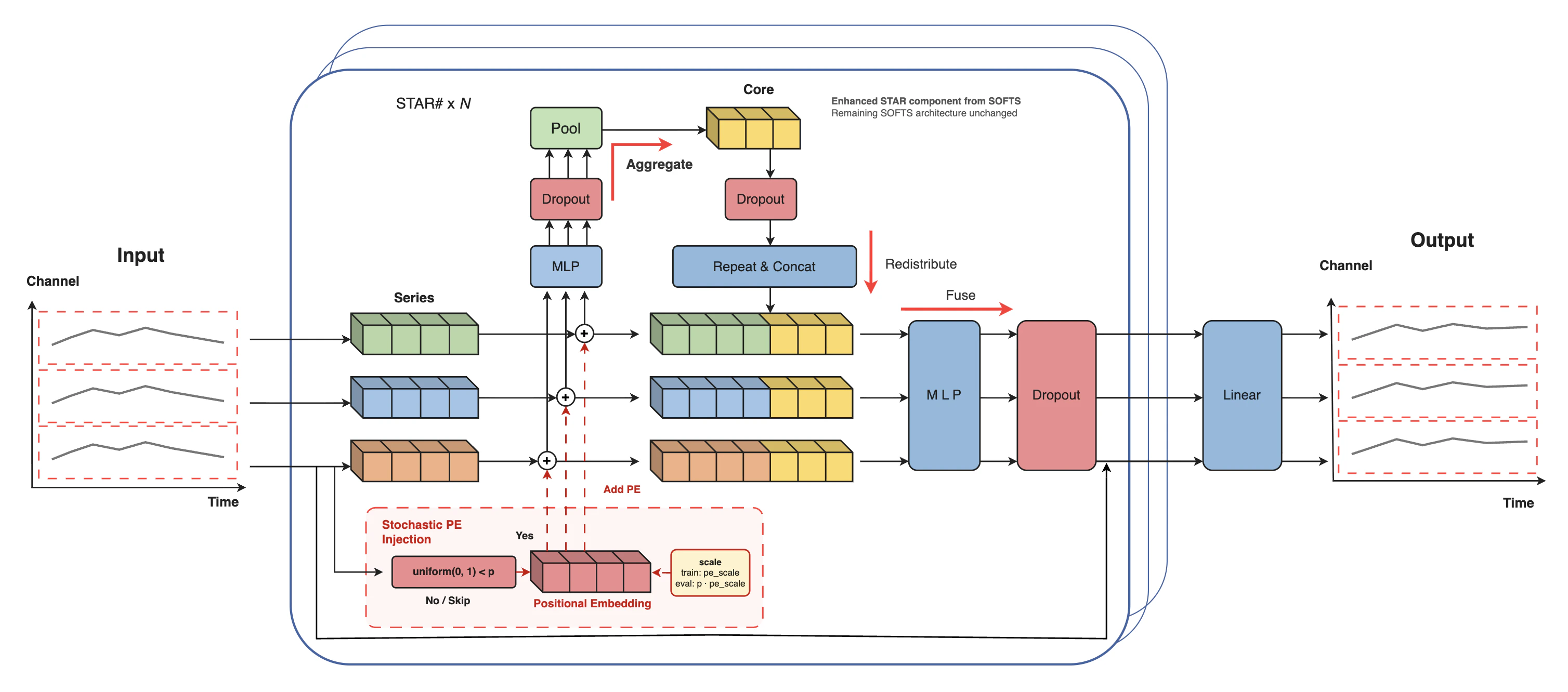
SOFTSSharp extends SOFTS by stochastically adding variable-position embeddings and multiple dropout layers inside the STAD aggregation-redistribution component, aiming to improve forecasting accuracy while preserving linear complexity.
Figure 1. Architecture of SOFTSSharp
1. SOFTSSharp
SOFTSSharp
SOFTSSharp(
h,
input_size,
n_series,
futr_exog_list=None,
hist_exog_list=None,
stat_exog_list=None,
exclude_insample_y=False,
hidden_size=512,
d_core=512,
e_layers=2,
d_ff=2048,
dropout=0.1,
pe_keep_prob=0.5,
use_norm=True,
loss=MAE(),
valid_loss=None,
max_steps=1000,
learning_rate=0.001,
num_lr_decays=-1,
early_stop_patience_steps=-1,
val_monitor="ptl/val_loss",
val_check_steps=100,
batch_size=32,
valid_batch_size=None,
windows_batch_size=32,
inference_windows_batch_size=32,
start_padding_enabled=False,
training_data_availability_threshold=0.0,
step_size=1,
scaler_type="identity",
random_seed=1,
drop_last_loader=False,
alias=None,
optimizer=None,
optimizer_kwargs=None,
lr_scheduler=None,
lr_scheduler_kwargs=None,
dataloader_kwargs=None,
**trainer_kwargs
)
Bases: BaseModel
SOFTSSharp
SOFTS# (SOFTSSharp) extends SOFTS by stochastically adding
variable-position embeddings and multiple dropout layers inside the STAD
component.
Parameters:
| Name | Type | Description | Default |
|---|
h | int | Forecast horizon. | required |
input_size | int | Autoregressive inputs size. | required |
n_series | int | Number of time-series. | required |
hidden_size | int | Dimension of the model. | 512 |
d_core | int | Dimension of core in STADSharp. | 512 |
e_layers | int | Number of encoder layers. | 2 |
d_ff | int | Dimension of fully-connected layer. | 2048 |
dropout | float | Dropout rate. | 0.1 |
pe_keep_prob | float | probability of applying variable-position encoding during training. During inference, the positional encoding is scaled by this value. | 0.5 |
use_norm | bool | Whether to normalize or not. | True |
loss | PyTorch module | Instantiated train loss class from losses collection. | MAE() |
valid_loss | PyTorch module | Instantiated valid loss class from losses collection. | None |
max_steps | int | Maximum number of training steps. | 1000 |
learning_rate | float | Learning rate between (0, 1). | 0.001 |
num_lr_decays | int | Number of learning rate decays, evenly distributed across max_steps. | -1 |
early_stop_patience_steps | int | Number of validation iterations before early stopping. | -1 |
val_monitor | str | Metric to monitor for early stopping. | ‘ptl/val_loss’ |
val_check_steps | int | Number of training steps between every validation loss check. | 100 |
batch_size | int | Number of different series in each batch. | 32 |
valid_batch_size | int | Number of different series in each validation and test batch, if None uses batch_size. | None |
windows_batch_size | int | Number of windows to sample in each training batch, default uses all. | 32 |
inference_windows_batch_size | int | Number of windows to sample in each inference batch, -1 uses all. | 32 |
start_padding_enabled | bool | If True, the model will pad the time series with zeros at the beginning, by input size. | False |
step_size | int | Step size between each window of temporal data. | 1 |
scaler_type | str | Type of scaler for temporal inputs normalization. | ‘identity’ |
random_seed | int | Random seed for pytorch initializer and numpy generators. | 1 |
drop_last_loader | bool | If True TimeSeriesDataLoader drops last non-full batch. | False |
alias | str | Optional custom name of the model. | None |
SOFTSSharp.fit
fit(
dataset, val_size=0, test_size=0, random_seed=None, distributed_config=None
)
Fit.
The fit method, optimizes the neural network’s weights using the
initialization parameters (learning_rate, windows_batch_size, …)
and the loss function as defined during the initialization.
Within fit we use a PyTorch Lightning Trainer that
inherits the initialization’s self.trainer_kwargs, to customize
its inputs, see PL’s trainer arguments.
The method is designed to be compatible with SKLearn-like classes
and in particular to be compatible with the StatsForecast library.
By default the model is not saving training checkpoints to protect
disk memory, to get them change enable_checkpointing=True in __init__.
Parameters:
| Name | Type | Description | Default |
|---|
dataset | TimeSeriesDataset | NeuralForecast’s TimeSeriesDataset, see documentation. | required |
val_size | int | Validation size for temporal cross-validation. | 0 |
random_seed | int | Random seed for pytorch initializer and numpy generators, overwrites model.init’s. | None |
test_size | int | Test size for temporal cross-validation. | 0 |
Returns:
SOFTSSharp.predict
predict(
dataset,
test_size=None,
step_size=1,
random_seed=None,
quantiles=None,
h=None,
explainer_config=None,
**data_module_kwargs
)
Predict.
Neural network prediction with PL’s Trainer execution of predict_step.
Parameters:
| Name | Type | Description | Default |
|---|
dataset | TimeSeriesDataset | NeuralForecast’s TimeSeriesDataset, see documentation. | required |
test_size | int | Test size for temporal cross-validation. | None |
step_size | int | Step size between each window. | 1 |
random_seed | int | Random seed for pytorch initializer and numpy generators, overwrites model.init’s. | None |
quantiles | list | Target quantiles to predict. | None |
h | int | Prediction horizon, if None, uses the model’s fitted horizon. Defaults to None. | None |
explainer_config | dict | configuration for explanations. | None |
**data_module_kwargs | dict | PL’s TimeSeriesDataModule args, see documentation. | |
Returns:
Usage example
import pandas as pd
import matplotlib.pyplot as plt
from neuralforecast import NeuralForecast
from neuralforecast.models import SOFTSSharp
from neuralforecast.utils import AirPassengersPanel, AirPassengersStatic
from neuralforecast.losses.pytorch import MASE
Y_train_df = AirPassengersPanel[AirPassengersPanel.ds<AirPassengersPanel['ds'].values[-12]].reset_index(drop=True)
Y_test_df = AirPassengersPanel[AirPassengersPanel.ds>=AirPassengersPanel['ds'].values[-12]].reset_index(drop=True)
model = SOFTSSharp(h=12,
input_size=24,
n_series=2,
hidden_size=256,
d_core=256,
e_layers=2,
d_ff=64,
dropout=0.1,
pe_keep_prob=0.5,
use_norm=True,
loss=MASE(seasonality=4),
early_stop_patience_steps=3,
batch_size=32)
fcst = NeuralForecast(models=[model], freq='ME')
fcst.fit(df=Y_train_df, static_df=AirPassengersStatic, val_size=12)
forecasts = fcst.predict(futr_df=Y_test_df)
fig, ax = plt.subplots(1, 1, figsize = (20, 7))
Y_hat_df = forecasts.reset_index(drop=False).drop(columns=['unique_id','ds'])
plot_df = pd.concat([Y_test_df, Y_hat_df], axis=1)
plot_df = pd.concat([Y_train_df, plot_df])
plot_df = plot_df[plot_df.unique_id=='Airline1'].drop('unique_id', axis=1)
plt.plot(plot_df['ds'], plot_df['y'], c='black', label='True')
plt.plot(plot_df['ds'], plot_df['SOFTSSharp'], c='blue', label='Forecast')
ax.set_title('AirPassengers Forecast', fontsize=22)
ax.set_ylabel('Monthly Passengers', fontsize=20)
ax.set_xlabel('Year', fontsize=20)
ax.legend(prop={'size': 15})
ax.grid()
2. Auxiliary functions
PositionalEmbedding
PositionalEmbedding(d_series, max_len=5000)
Bases: Module
STADSharp
STADSharp(d_series, d_core, dropout_rate=0.1, pe_keep_prob=0.5)
Bases: Module
STar Aggregate Dispatch Module with stochastic variable-position encoding.