Generate correlated sample paths for scenario analysis

Simulation vs. Prediction Intervals: When to Use Which

NeuralForecast provides two complementary approaches for reasoning about future uncertainty:

Prediction Intervals (predict(level=...))

Prediction intervals answer: “What range of values is the target likely to fall within at each future time step?”
  • Output: Independent confidence bands per horizon step (e.g., 90% interval at step hh).
  • Each step is treated marginally — no information about how steps relate to each other.
  • Best for: monitoring, alerting, dashboarding, reporting confidence bands.

Simulation Paths (simulate(...))

Simulation paths answer: “What are realistic joint future trajectories the time series could follow?”
  • Output: NN complete trajectories of length HH, each representing a plausible future.
  • Temporal correlations between steps are preserved — if step hh is high, step h+1h+1 is likely high too.
  • Best for: scenario analysis, portfolio optimization, supply chain planning, energy dispatch, risk assessment (VaR/CVaR), stochastic programming.

Key Difference: Marginal vs. Joint

Consider electricity price forecasting over 24 hours. A 90% prediction interval tells you the price at hour 12 will likely be between $40 and $80. But it says nothing about whether hours 11, 12, and 13 will all be high simultaneously (a sustained price spike) or whether high and low values alternate randomly. Simulation paths capture this joint structure. From 500 simulated paths you can compute: - P(total cost > budget) — requires summing across correlated hours - P(at least 3 consecutive hours above $70) — requires temporal ordering - Expected shortfall (CVaR) — requires the joint tail distribution These questions cannot be answered from marginal prediction intervals alone.

Available Simulation Methods

MethodTemporal CorrelationDescription
gaussian_copula (default)AR(1) Gaussian copulaDraws correlated uniform samples via Cholesky decomposition, maps through marginal CDFs. Parametric correlation structure.
schaake_shuffleEmpirical (historical templates)Draws independent marginal samples, reorders them to match rank structure of historical trajectory templates. Nonparametric — captures arbitrary dependence.
Compatible losses: - DistributionLoss (Normal, StudentT, Poisson, etc.) and mixture losses (GMM, PMM, NBMM) — produce arbitrary quantiles natively. - MQLoss / HuberMQLoss — uses the model’s trained quantile grid. - IQLoss / HuberIQLoss — evaluates multiple quantiles via repeated forward passes. - Point losses (MAE, MSE, etc.) — requires prediction_intervals (Conformal Prediction) set during fit() to build a quantile grid from calibration scores.

1. Setup

import logging
import warnings

import matplotlib.pyplot as plt
import numpy as np
import pandas as pd
import torch

warnings.filterwarnings("ignore")
logging.getLogger("pytorch_lightning").setLevel(logging.ERROR)
torch.set_float32_matmul_precision("high")

2. Load Data

We use the AirPassengers dataset — a classic monthly time series of airline passenger counts.
from neuralforecast.utils import AirPassengersDF

Y_df = AirPassengersDF.copy()
Y_train_df = Y_df[Y_df.ds <= "1959-12-31"]  # 132 months train
Y_test_df = Y_df[Y_df.ds > "1959-12-31"]    # 12 months test

print(f"Train: {len(Y_train_df)} rows, Test: {len(Y_test_df)} rows")
Y_train_df.tail()
2026-03-20 13:09:32,071 INFO util.py:154 -- Missing packages: ['ipywidgets']. Run `pip install -U ipywidgets`, then restart the notebook server for rich notebook output.
2026-03-20 13:09:32,151 INFO util.py:154 -- Missing packages: ['ipywidgets']. Run `pip install -U ipywidgets`, then restart the notebook server for rich notebook output.
Train: 132 rows, Test: 12 rows
unique_iddsy
1271.01959-08-31559.0
1281.01959-09-30463.0
1291.01959-10-31407.0
1301.01959-11-30362.0
1311.01959-12-31405.0

3. Train Models

We train five models showcasing different loss types: - NHITS + GMM — Gaussian Mixture Model, a mixture DistributionLoss. - NHITS + DistributionLoss(Normal) — parametric distribution output. - NHITS + MQLoss — Multi-Quantile Loss, directly optimizes quantile levels. - NHITS + IQLoss — Implicit Quantile Loss, can evaluate any quantile at inference. - NHITS + MAE with Conformal Prediction — point-loss model with calibrated prediction intervals. Since the MAE model needs conformal prediction intervals, we pass prediction_intervals to fit().
from neuralforecast import NeuralForecast
from neuralforecast.losses.pytorch import GMM, MAE, MQLoss, DistributionLoss, IQLoss
from neuralforecast.models import NHITS
from neuralforecast.utils import PredictionIntervals

H = 12
MAX_STEPS = 100

models = [
    NHITS(h=H, input_size=36, max_steps=MAX_STEPS, loss=GMM(), alias="NHITS_GMM", scaler_type="robust"),
    NHITS(h=H, input_size=36, max_steps=MAX_STEPS, loss=DistributionLoss(distribution="Normal"), alias="NHITS_Normal", scaler_type="robust"),
    NHITS(h=H, input_size=36, max_steps=MAX_STEPS, loss=MQLoss(level=[80, 90]), alias="NHITS_MQ", scaler_type="robust"),
    NHITS(h=H, input_size=36, max_steps=MAX_STEPS, loss=IQLoss(), alias="NHITS_IQL", scaler_type="robust"),
    NHITS(h=H, input_size=36, max_steps=MAX_STEPS, loss=MAE(), alias="NHITS_MAE", scaler_type="robust"),
]

nf = NeuralForecast(models=models, freq="MS")
nf.fit(
    df=Y_train_df,
    prediction_intervals=PredictionIntervals(n_windows=2, method="conformal_error"),
)

4. Prediction Intervals (Baseline)

First, let’s see the standard prediction intervals — these are marginal (per-step) uncertainty bands.

from utilsforecast.plotting import plot_series

fcst_df = nf.predict(level=[80, 90])
plot_series(Y_train_df, fcst_df, level=[80, 90], models=["NHITS_Normal"])
The shaded bands show the 80% and 90% prediction intervals. These are useful for understanding per-step uncertainty, but they do not capture the temporal correlation between forecast steps. Each band is computed independently.

5. Simulation Paths

Now let’s generate correlated simulation paths using the simulate() method. This returns a long-format DataFrame with columns [unique_id, ds, sample_id, model_1, model_2, ...].

Plotting helper

def extract_sims(sim_df, model_col, uid=None):
    """Extract simulation paths as a (n_paths, H) numpy array from simulate() output."""
    if uid is None:
        uid = sim_df["unique_id"].iloc[0]
    series = sim_df[sim_df["unique_id"] == uid]
    return series.pivot(index="sample_id", columns="ds", values=model_col).values


def plot_simulations(train_df, sims, model_name, title, color="steelblue", n_show=100):
    """Plot historical data with simulated future paths and derived prediction intervals."""
    fig, ax = plt.subplots(1, 1, figsize=(10, 4))
    
    # History (last 48 months)
    hist = train_df.sort_values("ds").tail(48)
    ax.plot(hist["ds"], hist["y"], color="black", linewidth=1.5, label="History")
    
    # Future dates
    last_date = hist["ds"].iloc[-1]
    future_dates = pd.date_range(start=last_date, periods=sims.shape[1] + 1, freq="MS")[1:]
    
    # Individual paths
    for i in range(min(n_show, sims.shape[0])):
        ax.plot(future_dates, sims[i], color=color, alpha=0.05, linewidth=0.5)
    
    # Derived prediction intervals from simulations
    for q_lo, q_hi, alpha in [(0.05, 0.95, 0.15), (0.10, 0.90, 0.25), (0.25, 0.75, 0.35)]:
        lo = np.quantile(sims, q_lo, axis=0)
        hi = np.quantile(sims, q_hi, axis=0)
        ax.fill_between(future_dates, lo, hi, color=color, alpha=alpha,
                        label=f"{int((q_hi - q_lo) * 100)}% PI")
    
    # Median
    median = np.median(sims, axis=0)
    ax.plot(future_dates, median, color=color, linewidth=2, label="Median")
    
    # Actual (if available)
    ax.plot(Y_test_df["ds"], Y_test_df["y"], color="black", linestyle="--", label="Actual")
    
    ax.set_title(f"{title}{model_name}")
    ax.legend(loc="upper left", fontsize=8)
    ax.set_xlabel("Date")
    ax.set_ylabel("Passengers")
    plt.tight_layout()
    plt.show()

Generate simulation paths

simulate() generates n_paths correlated sample paths for every model × series combination.
N_PATHS = 500
SEED = 42

sim_df = nf.simulate(n_paths=N_PATHS, seed=SEED)
sim_df.head(10)
unique_iddssample_idNHITS_GMMNHITS_NormalNHITS_MQNHITS_IQLNHITS_MAE
01.01960-01-010424.577554424.765725415.206802409.314326438.886536
11.01960-02-010404.827416404.260575414.203812388.755778416.497602
21.01960-03-010469.169496469.978479464.367880466.584470482.319912
31.01960-04-010450.245044451.145088454.416200462.261074459.493987
41.01960-05-010472.641135471.130120475.350769486.486899493.030374
51.01960-06-010528.117486527.280406539.266724497.874372530.030655
61.01960-07-010594.137207592.315796623.242188507.372412586.462607
71.01960-08-010604.532895604.907234617.977478531.723887583.457802
81.01960-09-010530.447128529.882652545.858492566.198389524.067964
91.01960-10-010458.686895458.105852466.378017466.831645468.689723

Visualize paths for each model

# Extract (n_paths, H) arrays for plotting
model_cols = [c for c in sim_df.columns if c not in ("unique_id", "ds", "sample_id")]

for model_col in model_cols:
    sims = extract_sims(sim_df, model_col)
    print(f"{model_col}: simulation paths shape = {sims.shape}")
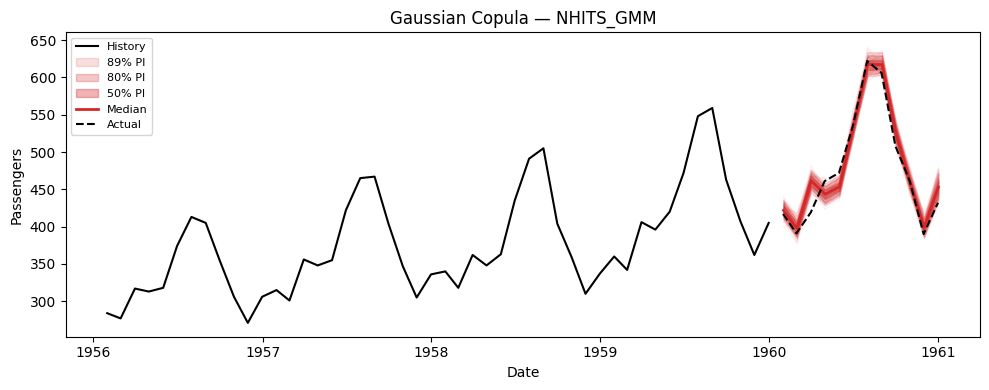
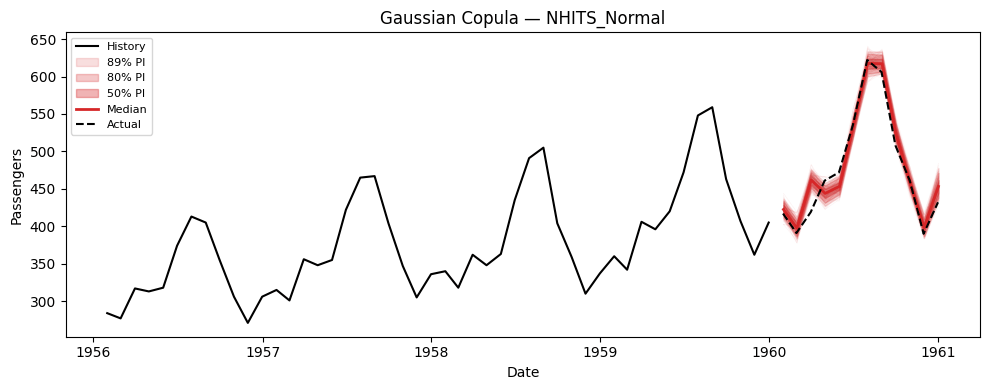
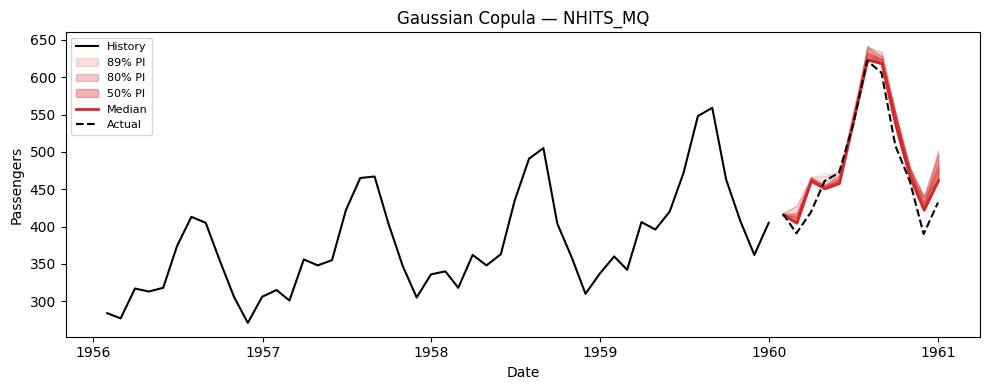
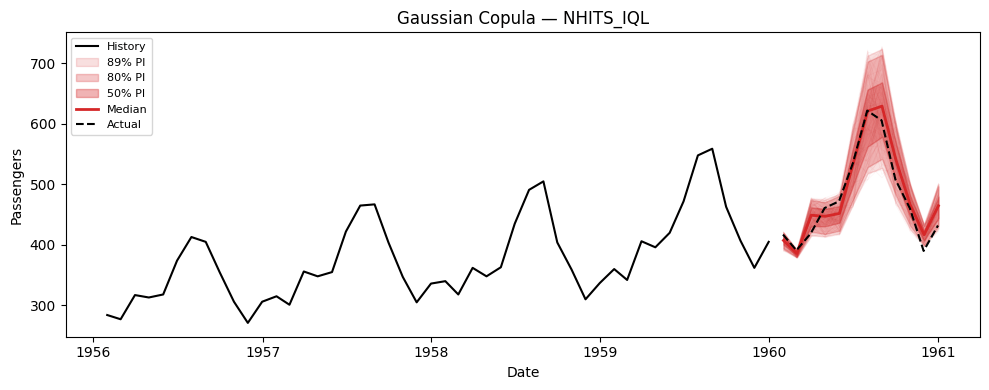
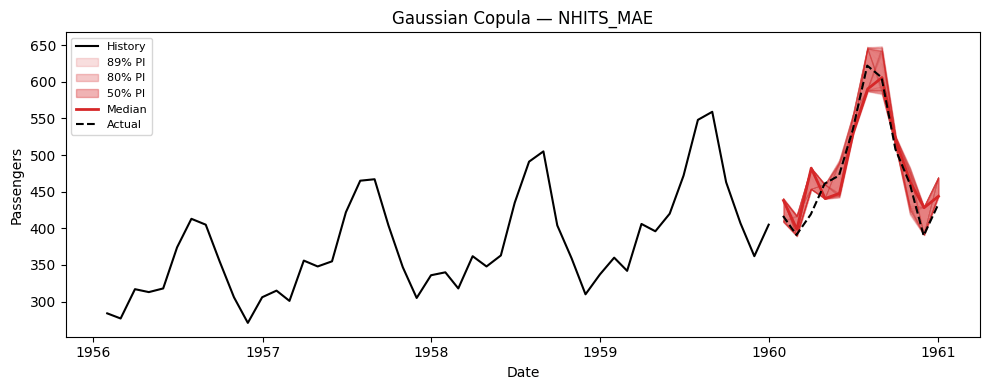
    plot_simulations(Y_train_df, sims, model_col, "Gaussian Copula", color="tab:red")
NHITS_GMM: simulation paths shape = (500, 12)
NHITS_Normal: simulation paths shape = (500, 12)
NHITS_MQ: simulation paths shape = (500, 12)
NHITS_IQL: simulation paths shape = (500, 12)
NHITS_MAE: simulation paths shape = (500, 12)

6. Using Simulation Paths for Decision-Making

The key advantage of simulation paths over prediction intervals is answering joint probabilistic questions. Here are concrete examples.

Example: Probability of exceeding a cumulative threshold

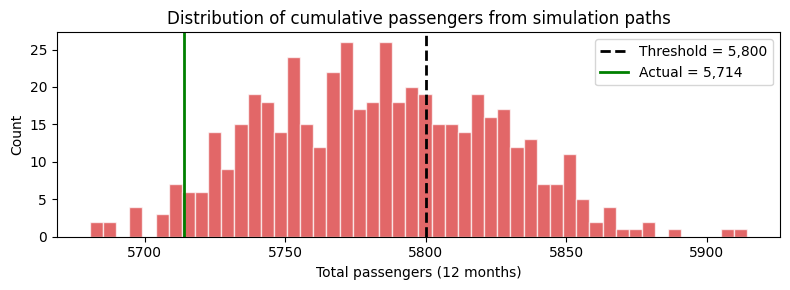
Suppose we have a capacity of 5,800 total passengers over the next 12 months. What is the probability of exceeding this capacity? This question requires the joint distribution — it cannot be answered from marginal intervals.
THRESHOLD = 5800

# Use NHITS_GMM simulations
sims_gmm = extract_sims(sim_df, "NHITS_GMM")
cumulative_passengers = sims_gmm.sum(axis=1)  # Sum across H=12 months per path
prob_exceed = (cumulative_passengers > THRESHOLD).mean()

print(f"P(total passengers > {THRESHOLD:,}) = {prob_exceed:.1%}")
print(f"Expected total passengers = {cumulative_passengers.mean():,.0f}")
print(f"5th percentile = {np.quantile(cumulative_passengers, 0.05):,.0f}")
print(f"95th percentile = {np.quantile(cumulative_passengers, 0.95):,.0f}")

fig, ax = plt.subplots(figsize=(8, 3))
ax.hist(cumulative_passengers, bins=50, color="tab:red", alpha=0.7, edgecolor="white")
ax.axvline(THRESHOLD, color="black", linestyle="--", linewidth=2, label=f"Threshold = {THRESHOLD:,}")
ax.axvline(Y_test_df["y"].sum(), color="green", linestyle="-", linewidth=2, label=f"Actual = {Y_test_df['y'].sum():,.0f}")
ax.set_xlabel("Total passengers (12 months)")
ax.set_ylabel("Count")
ax.set_title("Distribution of cumulative passengers from simulation paths")
ax.legend()
plt.tight_layout()
plt.show()
P(total passengers > 5,800) = 35.4%
Expected total passengers = 5,783
5th percentile = 5,720
95th percentile = 5,851

7. Comparing Simulation Methods: Gaussian Copula vs. Schaake Shuffle

Both methods use the same marginal quantile forecasts but differ in how they introduce temporal correlation across horizon steps. Let’s compare them on the NHITS_Normal model.
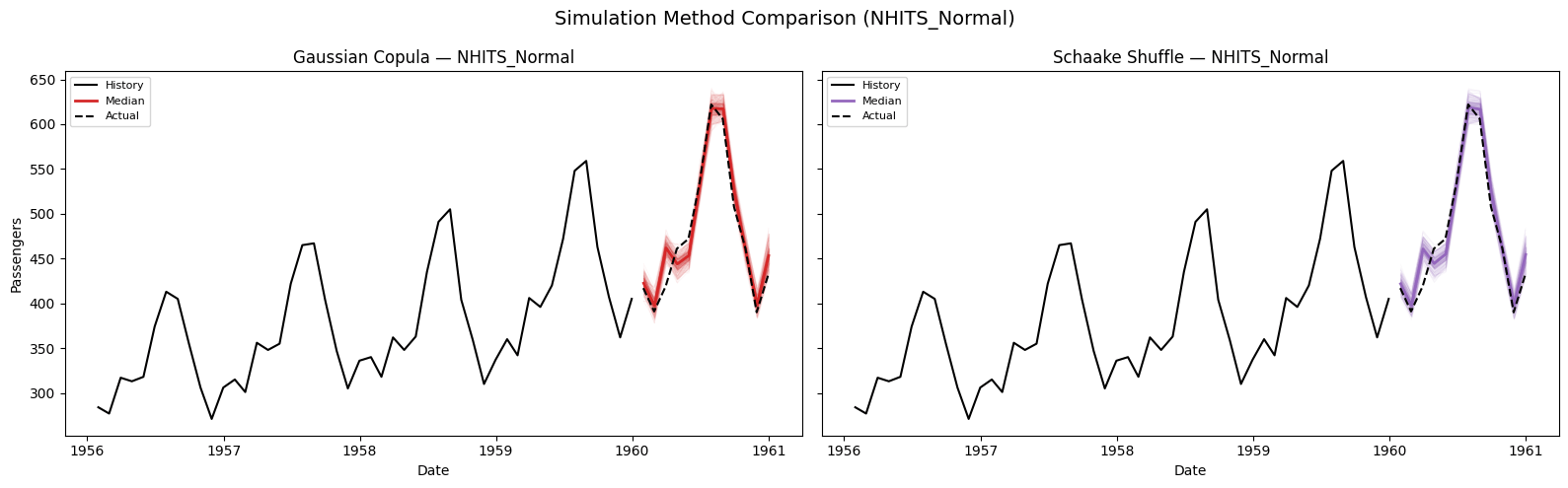
# Generate paths with both methods
sim_copula = nf.simulate(n_paths=N_PATHS, seed=SEED, method="gaussian_copula")
sim_schaake = nf.simulate(n_paths=N_PATHS, seed=SEED, method="schaake_shuffle")

sims_copula = extract_sims(sim_copula, "NHITS_Normal")
sims_schaake = extract_sims(sim_schaake, "NHITS_Normal")

# Side-by-side path comparison
fig, axes = plt.subplots(1, 2, figsize=(16, 5), sharey=True)
hist = Y_train_df.sort_values("ds").tail(48)
last_date = hist["ds"].iloc[-1]
future_dates = pd.date_range(start=last_date, periods=H + 1, freq="MS")[1:]

for ax, sims, title, color in zip(
    axes,
    [sims_copula, sims_schaake],
    ["Gaussian Copula", "Schaake Shuffle"],
    ["tab:red", "tab:purple"],
):
    ax.plot(hist["ds"], hist["y"], color="black", linewidth=1.5, label="History")
    for i in range(min(100, sims.shape[0])):
        ax.plot(future_dates, sims[i], color=color, alpha=0.05, linewidth=0.5)
    for q_lo, q_hi, alpha in [(0.05, 0.95, 0.15), (0.25, 0.75, 0.30)]:
        lo = np.quantile(sims, q_lo, axis=0)
        hi = np.quantile(sims, q_hi, axis=0)
        ax.fill_between(future_dates, lo, hi, color=color, alpha=alpha)
    median = np.median(sims, axis=0)
    ax.plot(future_dates, median, color=color, linewidth=2, label="Median")
    ax.plot(Y_test_df["ds"], Y_test_df["y"], color="black", linestyle="--", label="Actual")
    ax.set_title(f"{title} — NHITS_Normal")
    ax.set_xlabel("Date")
    ax.legend(loc="upper left", fontsize=8)

axes[0].set_ylabel("Passengers")
plt.suptitle("Simulation Method Comparison (NHITS_Normal)", fontsize=14)
plt.tight_layout()
plt.show()

8. Evaluating Marginal vs. Joint Distributions

We can evaluate both the marginal distribution (from predict(quantiles=...)) and the joint distribution (from simulate()) using the same metrics. For each model we compare:
  • Point metrics: MAE, MSE on the median forecast.
  • Probabilistic metric: scaled CRPS on the quantile forecasts — either from predict (marginal) or derived from simulation paths (joint).
If the simulation paths are well-calibrated, their empirical quantiles should score comparably to the model’s native marginal quantiles.
from utilsforecast.evaluation import evaluate
from utilsforecast.losses import mae, mse, scaled_crps

# ── Quantile grid for evaluation ──
eval_quantiles = np.round(np.arange(0.1, 1.0, 0.1), 2).tolist()  # [0.1, 0.2, ..., 0.9]

# We'll evaluate NHITS_Normal only for clarity
MODEL = "NHITS_Normal"

# ── 1. Marginal quantiles from predict() ──
marginal_df = nf.predict(quantiles=eval_quantiles)
# Add actuals — align by position (predict uses freq="MS" dates, test data has month-end dates)
marginal_df = marginal_df.sort_values(["unique_id", "ds"]).reset_index(drop=True)
marginal_df["y"] = Y_test_df.sort_values(["unique_id", "ds"])["y"].values

# ── 2. Joint quantiles derived from simulation paths (gaussian_copula) ──
sims_gc = extract_sims(sim_copula, MODEL)  # (n_paths, H)

joint_gc_df = marginal_df[["unique_id", "ds", "y"]].copy()
for q in eval_quantiles:
    joint_gc_df[f"{MODEL}_ql{q}"] = np.quantile(sims_gc, q, axis=0)
joint_gc_df[MODEL] = np.median(sims_gc, axis=0)

# ── 3. Joint quantiles derived from simulation paths (schaake_shuffle) ──
sims_ss = extract_sims(sim_schaake, MODEL)  # (n_paths, H)

joint_ss_df = marginal_df[["unique_id", "ds", "y"]].copy()
for q in eval_quantiles:
    joint_ss_df[f"{MODEL}_ql{q}"] = np.quantile(sims_ss, q, axis=0)
joint_ss_df[MODEL] = np.median(sims_ss, axis=0)
# ── Evaluate point metrics (via evaluate) ──
point_marginal = evaluate(marginal_df, metrics=[mae, mse], models=[MODEL], agg_fn="mean")
point_gc = evaluate(joint_gc_df, metrics=[mae, mse], models=[MODEL], agg_fn="mean")
point_ss = evaluate(joint_ss_df, metrics=[mae, mse], models=[MODEL], agg_fn="mean")

# ── Evaluate scaled CRPS (called directly — evaluate expects level-style columns) ──
quantile_cols = {MODEL: [f"{MODEL}_ql{q}" for q in eval_quantiles]}
quantiles_arr = np.array(eval_quantiles)

crps_marginal = scaled_crps(marginal_df, models=quantile_cols, quantiles=quantiles_arr)
crps_gc = scaled_crps(joint_gc_df, models=quantile_cols, quantiles=quantiles_arr)
crps_ss = scaled_crps(joint_ss_df, models=quantile_cols, quantiles=quantiles_arr)

# ── Combine results ──
results = pd.DataFrame({
    "Metric": ["MAE", "MSE", "Scaled CRPS"],
    "Marginal (predict)": [
        point_marginal[MODEL].values[0],
        point_marginal[MODEL].values[1],
        crps_marginal[MODEL].mean(),
    ],
    "Joint — Gaussian Copula": [
        point_gc[MODEL].values[0],
        point_gc[MODEL].values[1],
        crps_gc[MODEL].mean(),
    ],
    "Joint — Schaake Shuffle": [
        point_ss[MODEL].values[0],
        point_ss[MODEL].values[1],
        crps_ss[MODEL].mean(),
    ],
}).set_index("Metric")

print(f"Model: {MODEL}")
results
Model: NHITS_Normal
Marginal (predict)Joint — Gaussian CopulaJoint — Schaake Shuffle
Metric
MAE12.66957112.94217212.516764
MSE276.954919288.357154275.652889
Scaled CRPS0.0214400.0221330.021545
Interpreting the results:
  • MAE / MSE (point metrics): Both simulation methods use the median of the sample paths as their point forecast. Since the marginal quantiles and simulation-derived quantiles share the same underlying model, the median forecasts are similar but not identical — simulation introduces sampling variability.
  • Scaled CRPS (probabilistic metric): Measures the quality of the full quantile distribution. The marginal quantiles come directly from the model’s predictive distribution, while the simulation-derived quantiles are empirical (computed from n_paths samples). With enough paths, the simulation CRPS should converge to the marginal CRPS.

9. Summary

QuestionUse
“What range is step hh likely in?”predict(level=...) — prediction intervals
“What are realistic joint future trajectories?”simulate(n_paths=...) — sample paths
“What is P(total > threshold)?”simulate() then sum paths
“What is P(3 consecutive spikes)?”simulate() then check path patterns
“What is the CVaR of my portfolio?”simulate() then compute tail statistics

Simulation Methods

MethodUse when…
gaussian_copula (default)You want smooth, parametric temporal correlation (AR(1) structure). Fast and robust.
schaake_shuffleYou want nonparametric dependence from historical data. Captures asymmetric / non-Gaussian correlation patterns.

Compatible Losses

Loss typeHow quantiles are obtained
DistributionLoss, GMM, PMM, NBMMArbitrary quantiles from parametric distribution
MQLoss / HuberMQLossUses the model’s trained quantile grid
IQLoss / HuberIQLossMultiple forward passes, one per quantile
Point losses (MAE, MSE, etc.)Conformal Prediction intervals (requires prediction_intervals during fit())

References