

Tutorial on how to train and forecast Transformer models.Transformer models, originally proposed for applications in natural language processing, have seen increasing adoption in the field of time series forecasting. The transformative power of these models lies in their novel architecture that relies heavily on the self-attention mechanism, which helps the model to focus on different parts of the input sequence to make predictions, while capturing long-range dependencies within the data. In the context of time series forecasting, Transformer models leverage this self-attention mechanism to identify relevant information across different periods in the time series, making them exceptionally effective in predicting future values for complex and noisy sequences. Long horizon forecasting consists of predicting a large number of timestamps. It is a challenging task because of the volatility of the predictions and the computational complexity. To solve this problem, recent studies proposed a variety of Transformer-based models. The Neuralforecast library includes implementations of the following popular recent models:
Informer (Zhou, H. et al. 2021), Autoformer
(Wu et al. 2021), FEDformer (Zhou, T. et al. 2022), and PatchTST
(Nie et al. 2023).
Our implementation of all these models are univariate, meaning that only
autoregressive values of each feature are used for forecasting. We
observed that these unvivariate models are more accurate and faster than
their multivariate couterpart.
In this notebook we will show how to: * Load the
ETTm2 benchmark dataset, used
in the academic literature. * Train models * Forecast the test set
The results achieved in this notebook outperform the original
self-reported results in the respective original paper, with a fraction
of the computational cost. Additionally, all models are trained with the
default recommended parameters, results can be further improved using
our auto models with automatic hyperparameter selection.
You can run these experiments using GPU with Google Colab.

1. Installing libraries
2. Load ETTm2 Data
TheLongHorizon class will automatically download the complete ETTm2
dataset and process it.
It return three Dataframes: Y_df contains the values for the target
variables, X_df contains exogenous calendar features and S_df
contains static features for each time-series (none for ETTm2). For this
example we will only use Y_df.
If you want to use your own data just replace Y_df. Be sure to use a
long format and have a simmilar structure than our data set.
| unique_id | ds | y | |
|---|---|---|---|
| 0 | HUFL | 2016-07-01 00:00:00 | -0.041413 |
| 1 | HUFL | 2016-07-01 00:15:00 | -0.185467 |
| 57600 | HULL | 2016-07-01 00:00:00 | 0.040104 |
| 57601 | HULL | 2016-07-01 00:15:00 | -0.214450 |
| 115200 | LUFL | 2016-07-01 00:00:00 | 0.695804 |
| 115201 | LUFL | 2016-07-01 00:15:00 | 0.434685 |
| 172800 | LULL | 2016-07-01 00:00:00 | 0.434430 |
| 172801 | LULL | 2016-07-01 00:15:00 | 0.428168 |
| 230400 | MUFL | 2016-07-01 00:00:00 | -0.599211 |
| 230401 | MUFL | 2016-07-01 00:15:00 | -0.658068 |
| 288000 | MULL | 2016-07-01 00:00:00 | -0.393536 |
| 288001 | MULL | 2016-07-01 00:15:00 | -0.659338 |
| 345600 | OT | 2016-07-01 00:00:00 | 1.018032 |
| 345601 | OT | 2016-07-01 00:15:00 | 0.980124 |
3. Train models
We will train models using thecross_validation method, which allows
users to automatically simulate multiple historic forecasts (in the test
set).
The cross_validation method will use the validation set for
hyperparameter selection and early stopping, and will then produce the
forecasts for the test set.
First, instantiate each model in the models list, specifying the
horizon, input_size, and training iterations.
(NOTE: The FEDformer model was excluded due to extremely long training
times.)
Tip
Check our auto models for automatic hyperparameter optimization.
Instantiate a NeuralForecast object with the following required
parameters:
-
models: a list of models. -
freq: a string indicating the frequency of the data. (See panda’s available frequencies.)
cross_validation method, specifying the dataset
(Y_df), validation size and test size.
cross_validation method will return the forecasts for each model
on the test set.
| unique_id | ds | cutoff | Informer | Autoformer | PatchTST | y | |
|---|---|---|---|---|---|---|---|
| 0 | HUFL | 2017-10-24 00:00:00 | 2017-10-23 23:45:00 | -1.055062 | -0.861487 | -0.860189 | -0.977673 |
| 1 | HUFL | 2017-10-24 00:15:00 | 2017-10-23 23:45:00 | -1.021247 | -0.873399 | -0.865730 | -0.865620 |
| 2 | HUFL | 2017-10-24 00:30:00 | 2017-10-23 23:45:00 | -1.057297 | -0.900345 | -0.944296 | -0.961624 |
| 3 | HUFL | 2017-10-24 00:45:00 | 2017-10-23 23:45:00 | -0.886652 | -0.867466 | -0.974849 | -1.049700 |
| 4 | HUFL | 2017-10-24 01:00:00 | 2017-10-23 23:45:00 | -1.000431 | -0.887454 | -1.008530 | -0.953600 |
4. Evaluate Results
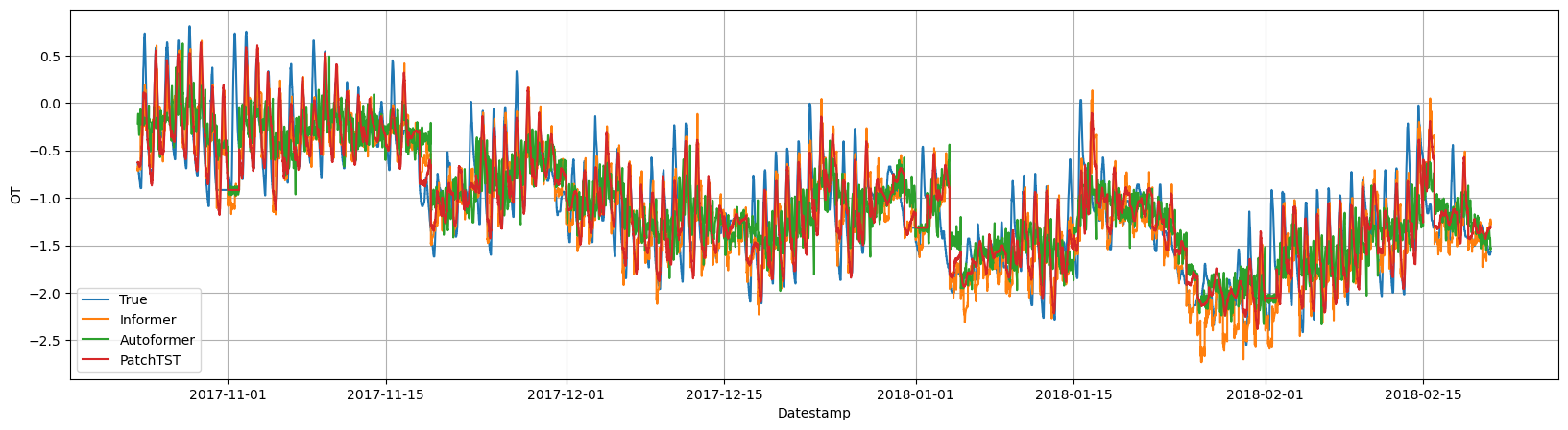
Next, we plot the forecasts on the test set for theOT variable for
all models.
| Horizon | PatchTST | AutoFormer | Informer | ARIMA |
|---|---|---|---|---|
| 96 | 0.256 | 0.339 | 0.453 | 0.301 |
| 192 | 0.296 | 0.340 | 0.563 | 0.345 |
| 336 | 0.329 | 0.372 | 0.887 | 0.386 |
| 720 | 0.385 | 0.419 | 1.388 | 0.445 |
Next steps
We proposed an alternative model for long-horizon forecasting, theNHITS, based on feed-forward networks in (Challu et al. 2023). It
achieves on par performance with PatchTST, with a fraction of the
computational cost. The NHITS tutorial is available
here.