

StatsForecastAdapter is the most capable adapter in the package: it is
the only one whose support for every capability is unconditional, so all
six methods work behind it whatever model you wrap.
NeuralForecastAdapter declares the same set, but its quantile support
depends on the model’s loss.
Fit first, wrap second
The adapter does not fit anything. Build and fit yourStatsForecast
object exactly as you normally would, then hand it over along with the
frame it was trained on as the adapter needs that to reconstruct
histories at the right frequency.
model_name picks one column out of the fitted output. One adapter
speaks for one model, so wrapping the same sf twice conformalizes two
of its models independently.
One caveat on sharing a multi-modelStatsForecastCross-validation runs at theStatsForecastlevel, not per column. If the object holds several models and any of them lacks aforwardmethod,refit=Falsefails for all of them — even for an adapter that only reads theAutoETScolumn. That is why this page builds a secondStatsForecastbelow rather than addingSeasonalNaiveto the one above.
Calibrating
refitdepends on the model, not on youcalibrate_cv(refit=False)— the default — asks statsforecast to reuse fitted parameters across cutoffs via each model’sforwardmethod.AutoETShas one, so the call above is fast.SeasonalNaivedoes not, and statsforecast raisesValueError: ... The following models do not implement the forward method— passrefit=Truefor those.
Polars frames
The adapter takes a polarstrain_df just as well, and
conformalforecast installs neither library. Pass the same freq you
gave StatsForecast; for polars that is a polars interval, "1h", rather
than the pandas alias "h". Every frame the adapter hands StatsForecast
stays polars, and the calibrated quantile matches the pandas run.
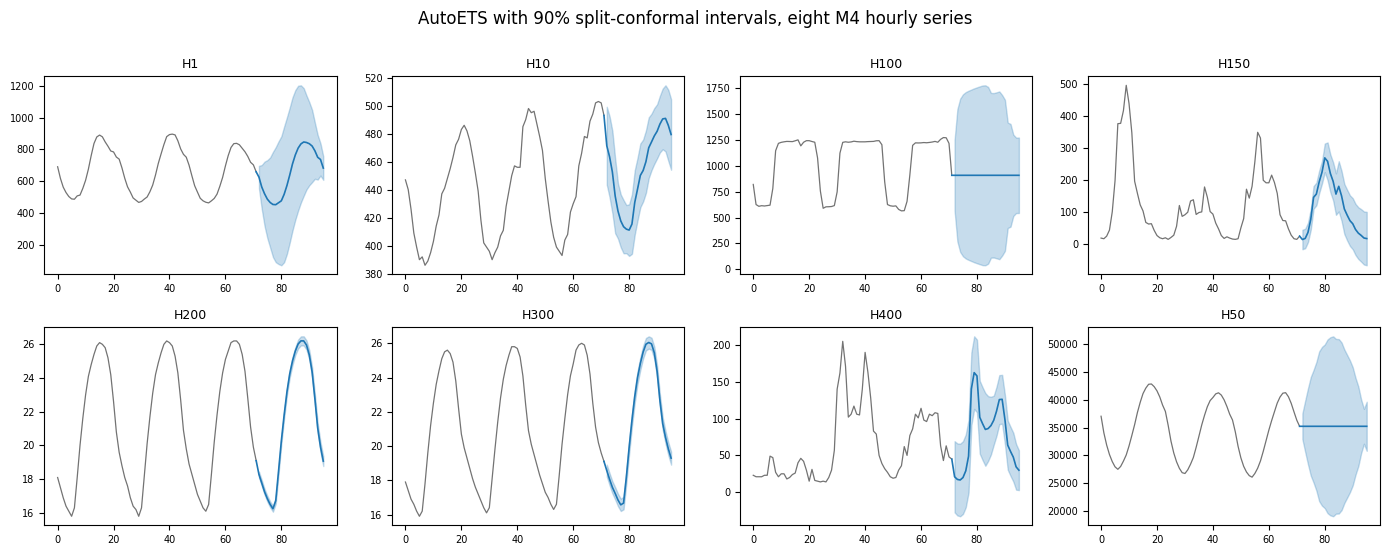
Per-series intervals
Quantiles, and CQR
StatsForecastAdapter exposes statsforecast’s analytical prediction
intervals as quantiles, which is what makes CQR
available.
Two rules statsforecast imposes on quantiles
- Symmetric pairs only. Quantiles are requested through statsforecast’s level API, so 0.05 must be accompanied by 0.95. Asking for an unpaired quantile raises
ValueErrorin the adapter. This is shared with the mlforecast and neuralforecast adapters, so asymmetric CQR (symmetric=False) is out of reach for all three — see CQR for the detail.- No median.
q == 0.5is rejected; the level API has no column for it.alphais translated into a legal pair for you, so you only meet these rules if you specify levels by hand.
Exogenous regressors
Anexog_features argument tells the adapter which columns of
train_df are regressors rather than the target.
Declaringexog_featuresremoves the quantile capability This is the package’s canonical example of a capability that depends on configuration rather than on class.StatsForecastAdapteroverridessupports(): with exogenous regressors declared,predict_quantilescannot be served, soSupportsQuantilesreportsFalseand calibrating CQR on that adapter raisesUnsupportedCapabilityas soon as it is bound, before any forecasting happens. Note also that the exogenouspredictpath is a known gap in v0.1 (it isxfail-marked in the integration suite). See Exogenous features for what does work today.
Measured coverage across the panel
SeasonalNaive produces
intervals nearly three times narrower than AutoETS for two points less
coverage, and a Winkler score a third the size. On strongly periodic
hourly data the naive seasonal forecast is simply more accurate, and
conformal prediction inherits that: a better point forecast is the
cheapest way to a narrower interval, and no amount of calibration will
rescue a poor one.
CQR comes out worse than split conformal here on all three numbers —
80.3% against 87.4%, wider, higher Winkler. CQR inherits the shape of
the model’s own quantiles, and AutoETS’s analytical band on an hourly
series with a 24-hour season is a poor guide to where the errors
actually fall. Conformal calibration can shift that band up or down; it
cannot reshape it. Inheriting a shape is only an advantage when the
shape is right.
And the per-series breakdown spans 69.8% to 100% around an 87.4%
marginal. The two worst are H150 and H400, and the panel-level
number tells you nothing about them — see ragged
panels for why per-series diagnostics
are the ones to watch.
Next
- MLForecast — the same panel through a gradient-boosted model.
- NeuralForecast — and through a neural one.
- Adapters — the capability matrix and how to write your own.
- Methods — all six work behind this adapter.