

NeuralForecastAdapter wraps a trained NeuralForecast object. Two
things about it differ from the other adapters, and both come from how
neuralforecast models are configured.
The horizon comes from the model
NeuralForecastAdapter takes no horizon argument. A
neuralforecast model is built with its own h, and the adapter reads
it. Copy the constructor call from the StatsForecast
page, add horizon=, and you get a TypeError. If the
NeuralForecast holds several models they must all agree on h.
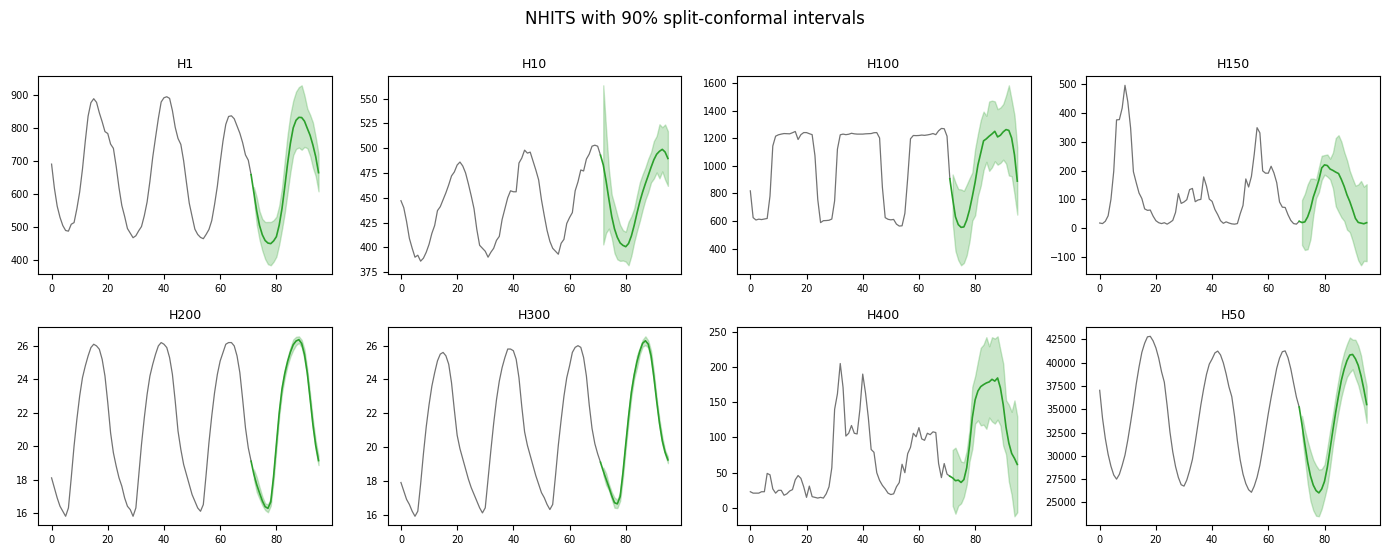
scaler_typematters as much as it does for a boosted model These eight series span three orders of magnitude.scaler_type="standard"normalises per series inside the model; without it, the network fits the largest series and ignores the rest — the same failure the MLForecast page documents for unscaled trees.
Quantile capability depends on the loss
This is the package’s clearest example of a capability that is a property of the instance, not the class. A neuralforecast model trained with a point loss cannot produce quantiles; the same class trained withMQLoss can. So NeuralForecastAdapter overrides
supports() to inspect the loss.
MQLoss needs the quantile levels it will be asked for — alpha=0.1
means the pair (0.05, 0.95).
calibrate_cv does, so the failure above
cost nothing — no cross-validation ran. That is the rule the package
holds to everywhere: capability errors surface where the forecaster is
bound, never inside predict.
Measured coverage
MQLoss model with CQR beats the point model with split conformal
on all three numbers — better coverage, narrower, lower Winkler. That is
the shape CQR has when a model’s own quantiles carry real information
about where its errors fall, and it is worth contrasting with the
StatsForecast page, where CQR loses for exactly the
opposite reason.
max_steps=100is a documentation setting Both models here train for 100 steps so this page builds in seconds. That is far short of convergence, and the intervals are correspondingly wide — conformal prediction is honest about an undertrained model rather than hiding it. Raisemax_stepsfor anything real; the calibration code is unchanged.
Next
- StatsForecast — per-series statistical models.
- MLForecast — a global gradient-boosted model.
- CQR — what the
MQLosspath above feeds. - Adapters — the capability matrix in full.