

The model The observed series is driven by a hidden volatility process that evolves stochastically over time; the two can be correlated (a leverage effect). Because volatility is latent and mean-reverting, bursts arrive and fade more smoothly than under GARCH.
1. Heston model (1 year daily)
The Heston model features mean-reverting stochastic variance with a leverage effect (negative correlation between price and volatility).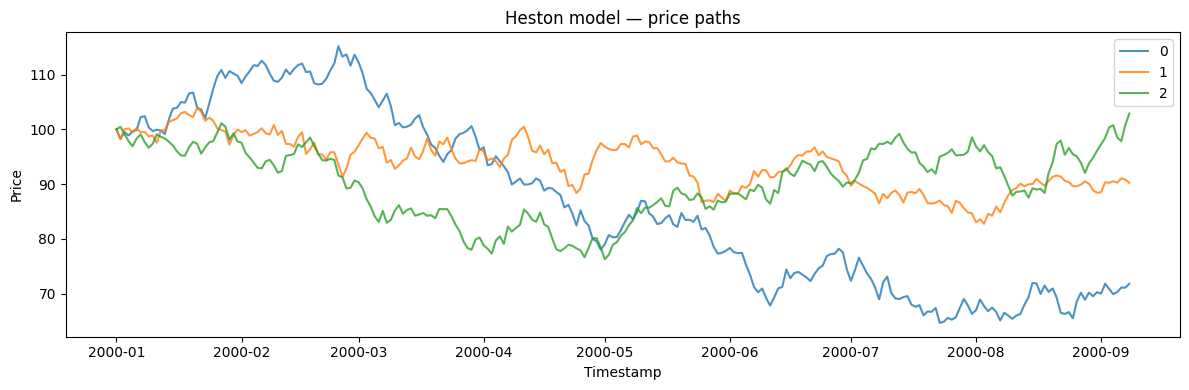
2. Price and volatility paths
Generate both the price and volatility paths to observe their joint dynamics.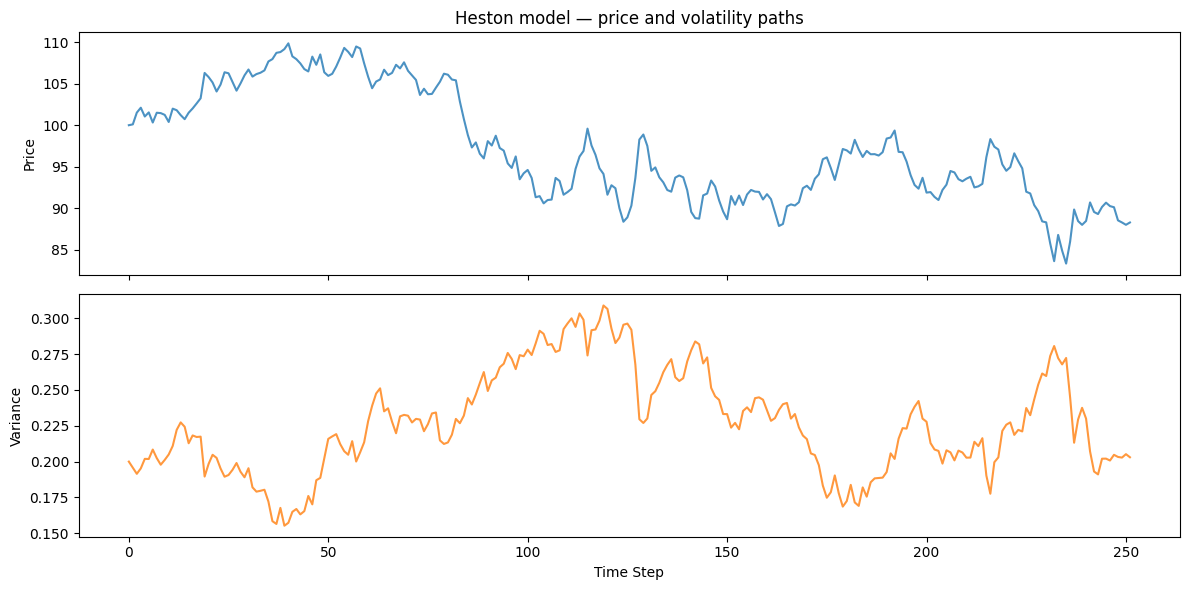
3. Leverage effect (price-vol correlation)
Verify that returns and volatility changes are negatively correlated (leverage effect).4. SABR model
The SABR (Stochastic Alpha Beta Rho) model is widely used for interest rate derivatives and allows a CEV exponent (beta) to control the volatility smile shape.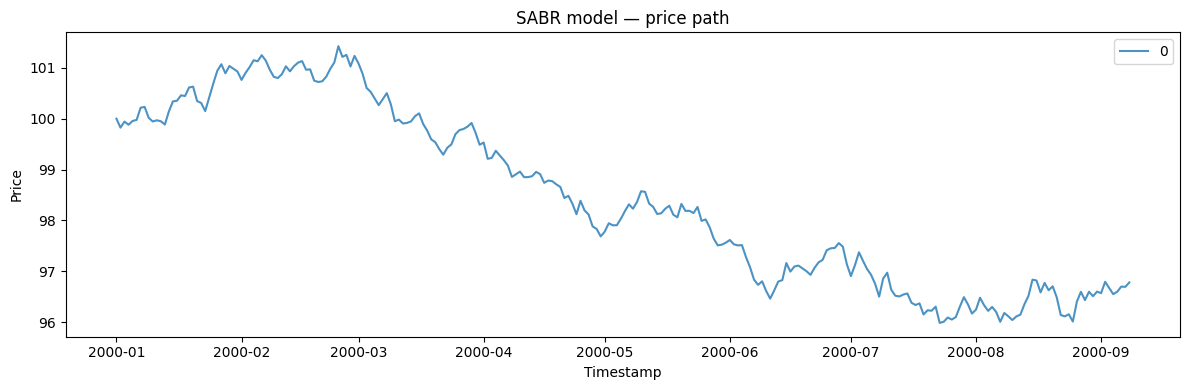
5. Model information
Inspect the full model parameters.6. Implied volatility smile (SABR)
Compute the implied volatility smile from the SABR model for various strike prices.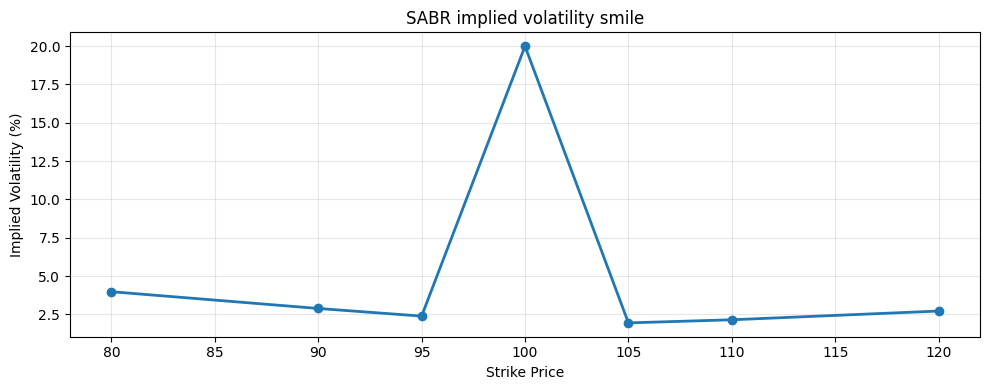
7. Output types
The generator supports different output types: price, returns, and volatility.Related generatorsModel parameters are in the generator reference.
- GARCH — deterministic-recursion volatility clustering.
- Ornstein-Uhlenbeck — the mean-reverting process often used for the latent variance.