

The model A continuous diffusion accumulates small changes while a Poisson jump process adds occasional discrete moves. The jump intensity sets how often jumps occur; the jump-size distribution sets how large they are. Between jumps the series behaves like its underlying diffusion.
1. Jump intensity
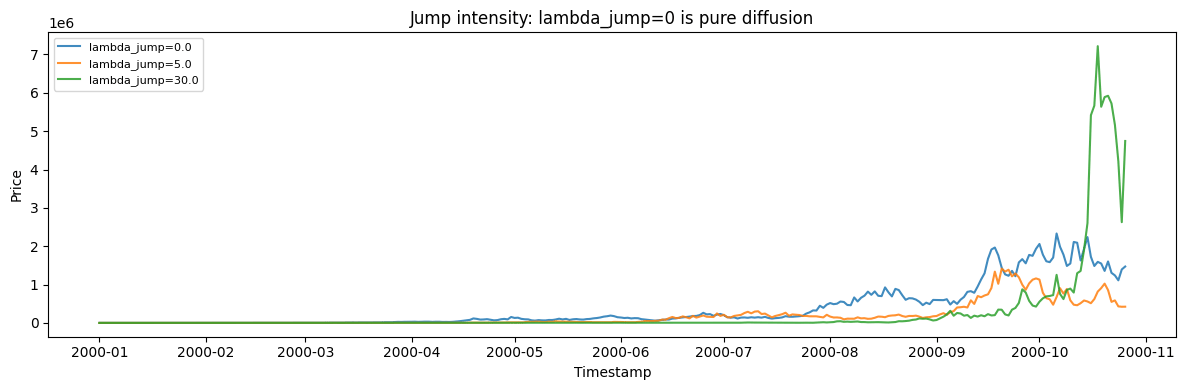
lambda_jump is the expected number of jumps per unit time. Between
jumps the path is an ordinary diffusion, so raising it adds
discontinuities without changing the underlying drift.
2. Jump direction
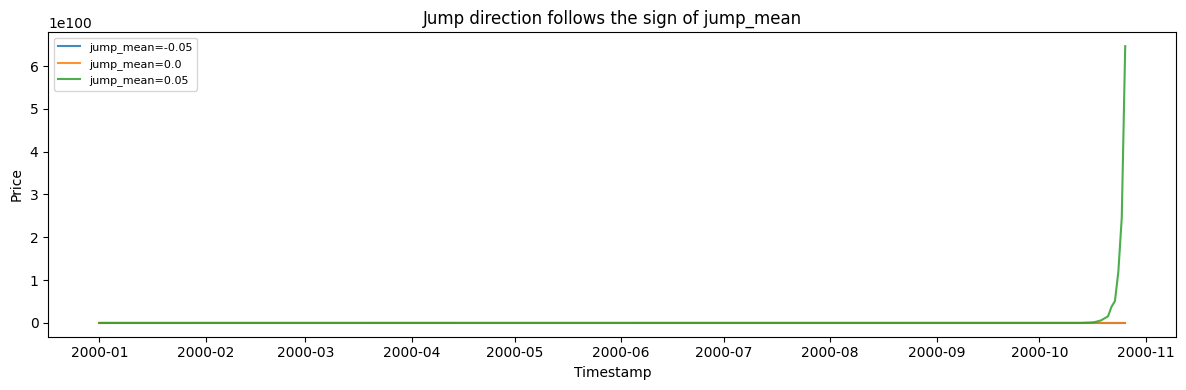
jump_mean is the average log jump size, so its sign decides whether
shocks push the price up or down. The drift is not compensated for
jumps, which is why a negative mean drags the whole path down.
3. Multiple series
Generate multiple independent jump diffusion paths.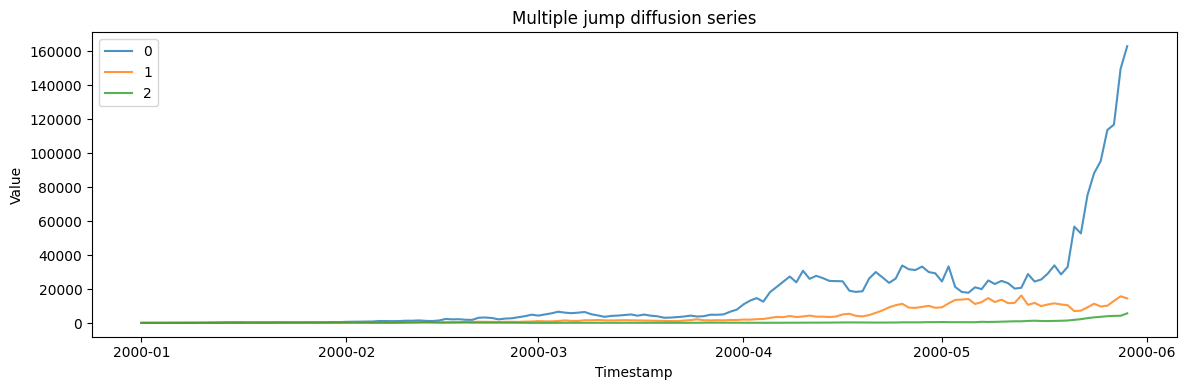
Related generatorsJump intensity and size parameters are in the generator reference.
- Geometric Brownian motion — the jump-free diffusion.
- Hawkes process — when the jumps cluster and self-excite.