

The model The arrival intensity is a baseline rate plus a decaying kick after every event, so activity begets activity. The excitation strength and decay set how tightly events cluster and how long a burst lasts; below a stability threshold the process stays finite.
1. Event counts (default output)
Generate event count time series with a baseline intensity and self-excitation.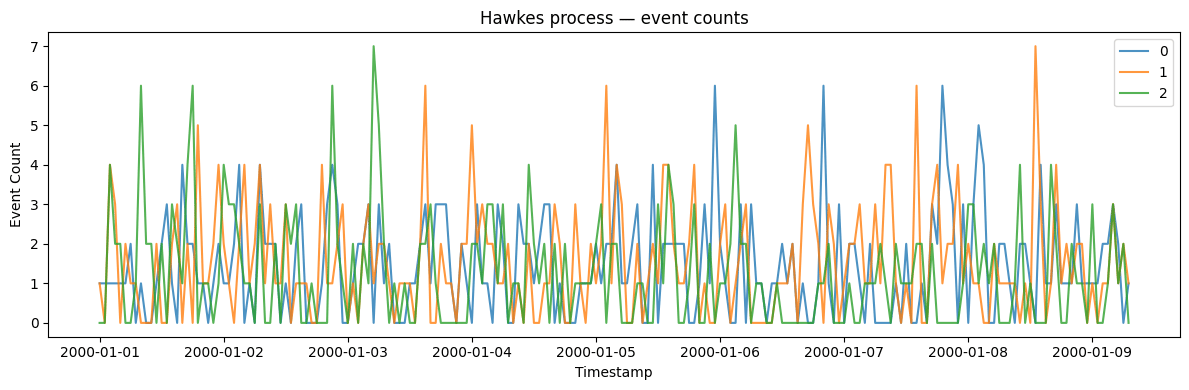
2. Intensity process
Output the underlying intensity function instead of event counts.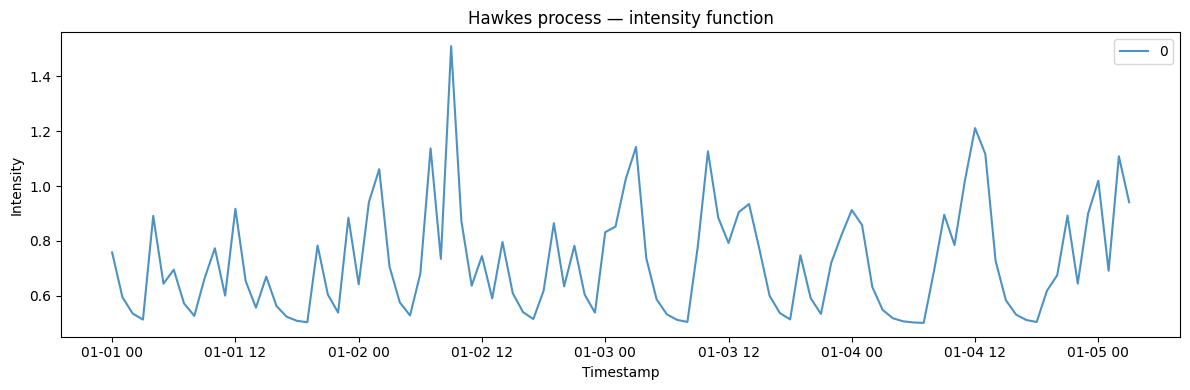
3. Model information and stability
Inspect model parameters including the branching ratio which determines stability.4. Raw event simulation
Directly simulate event arrival times and their associated intensities.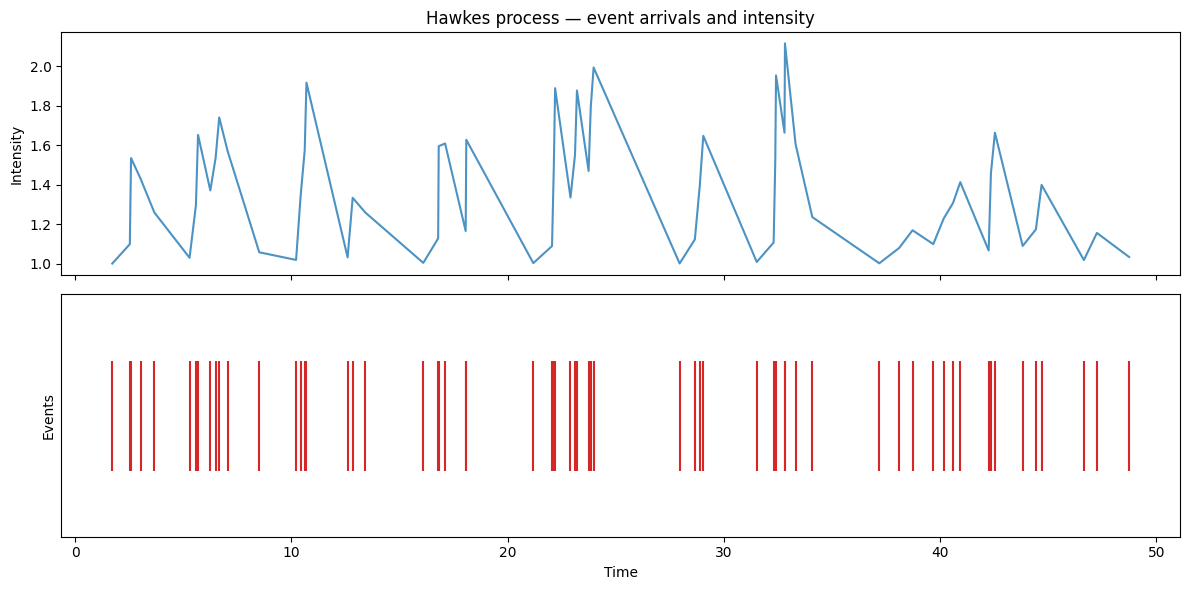
5. Power-law kernel
Use a power-law decay kernel instead of the default exponential kernel for longer memory effects.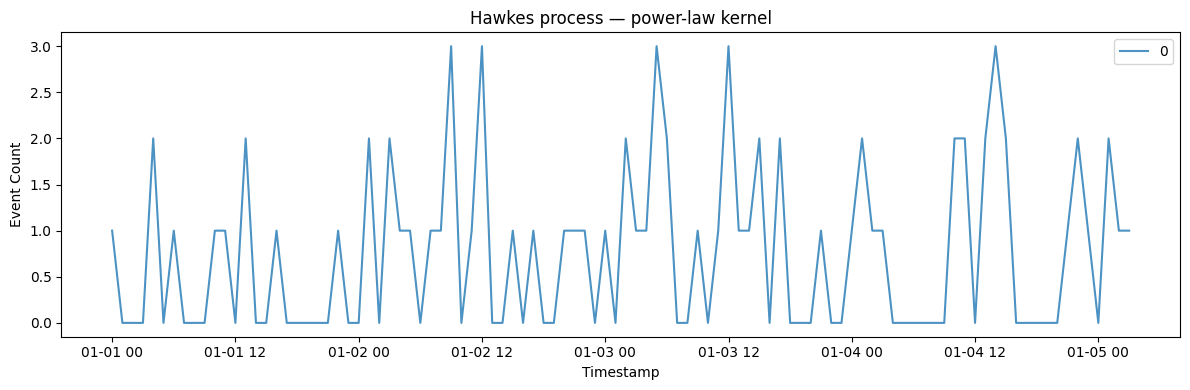
Related generatorsExcitation and decay parameters are in the generator reference.
- Poisson process — the no-excitation baseline.
- Jump diffusion — continuous dynamics with discrete shocks.