

The model The Hurst exponenthurst∈ (0, 1) sets the correlation of increments:H = 0.5is ordinary Brownian motion,H > 0.5is persistent (long-range positive dependence, smooth trends), andH < 0.5is anti-persistent (rough, mean-reverting).
Comparing Hurst exponents
Generate series with different Hurst exponents and estimate the Hurst parameter back from the data using the R/S method.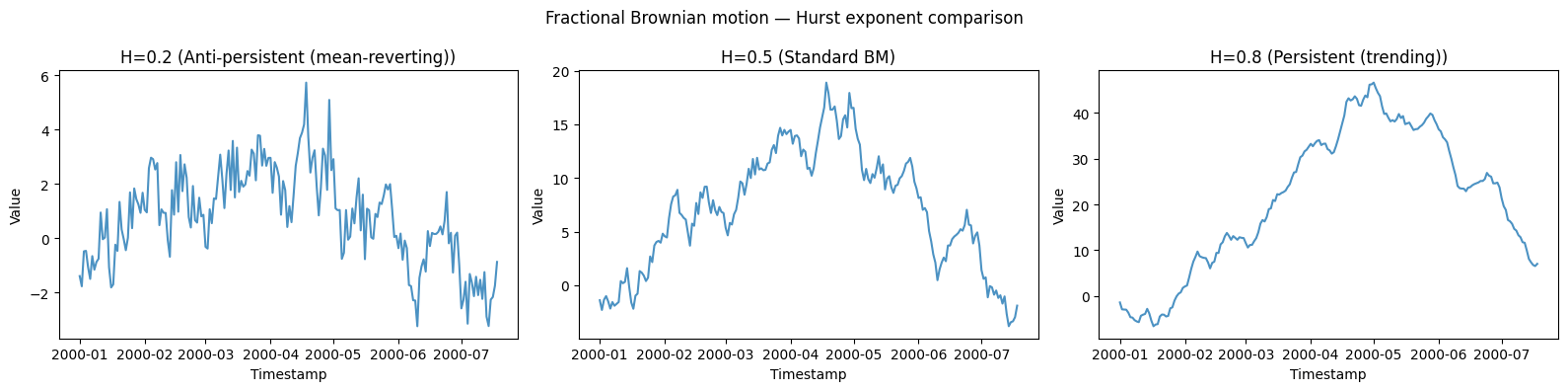
Comparing fBm vs fGn (Increments)
Fractional Brownian motion (fBm) is the cumulative process, while fractional Gaussian noise (fGn) represents its increments.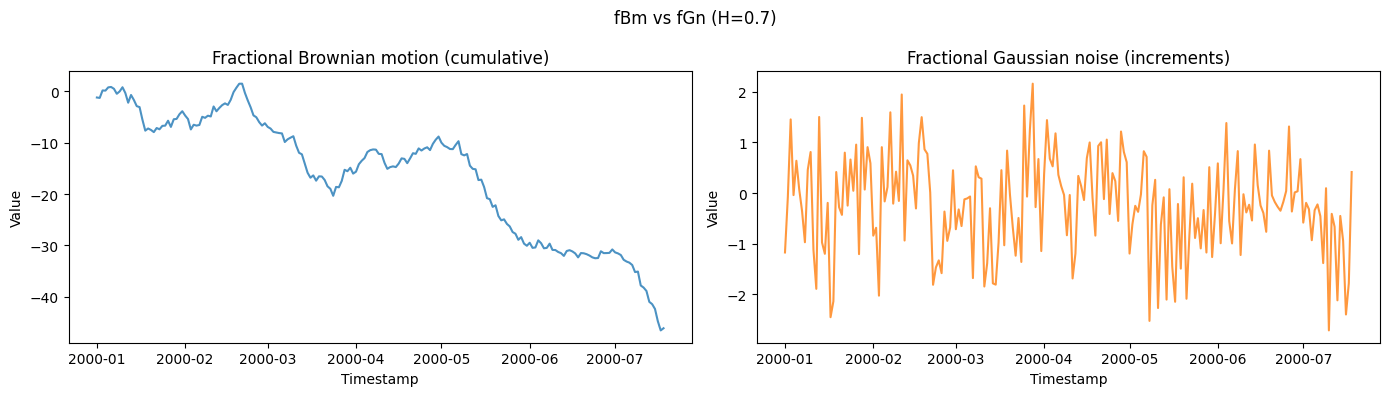
Model information
Inspect the model parameters and metadata.Related generatorsThe Hurst parameter is documented in the generator reference.
- Random walk — the
H = 0.5special case.- Ornstein-Uhlenbeck — a different route to mean reversion.