

The model
A latent Markov chain over n_regimes states controls which dynamics
generate each step; a transition matrix sets how sticky each regime
is. The result is piecewise-stationary data with structural breaks
that recur rather than happen once.
Bull/Bear market model
Define a two-regime model where the bull regime has positive mean and low variance, while the bear regime has negative mean and high variance.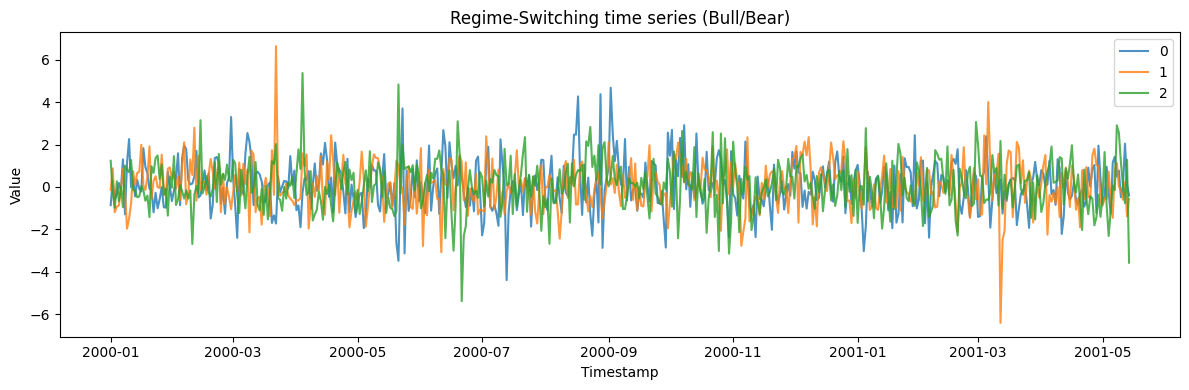
Model information
Inspect model parameters including the stationary distribution of the Markov chain.Regime labels
Generate data with regime labels to see how observations are distributed across regimes.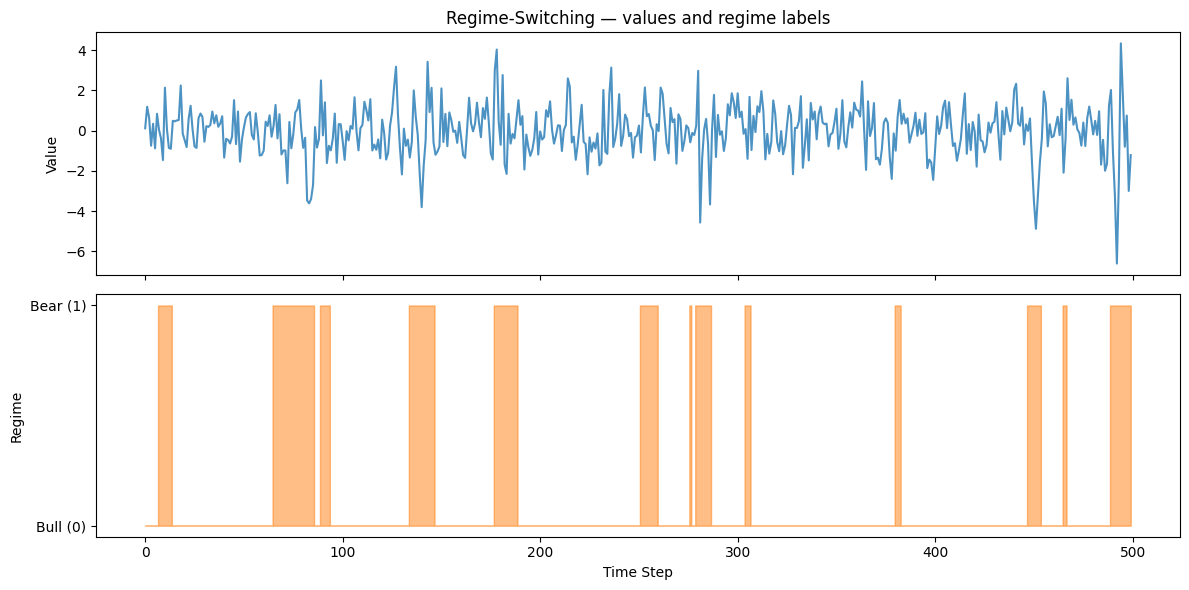
Statistics by series
Compare summary statistics across the generated series.Related generatorsRegime and transition parameters are in the generator reference.
- Changepoints — one-off structural breaks rather than recurring regimes.
- GARCH — smoothly varying volatility instead of discrete states.