

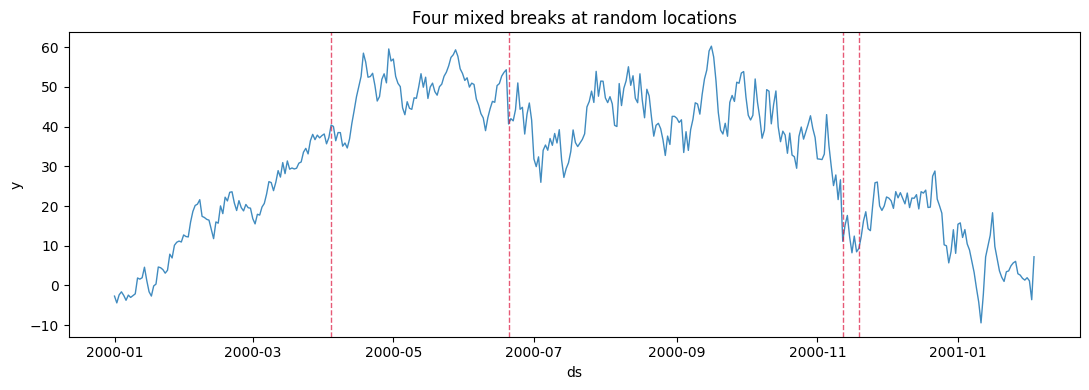
Types and placementchangepoint_typeselects what breaks —"level","trend","variance", or"mixed". Setchangepoint_locations(fractions of the series) and the matchingchangepoint_*_changesto place breaks exactly, or give onlynum_changepointsto scatter them randomly.exogenous=ExogenousConfig(changepoint_flags=True)adds achangepoint_flagcolumn marking each break — drawn as dashed vertical lines below.
Level breaks
The most common structural break: the series jumps to a new baseline. Here three breaks at 20%, 50%, and 80% of the series, with explicit jump sizes.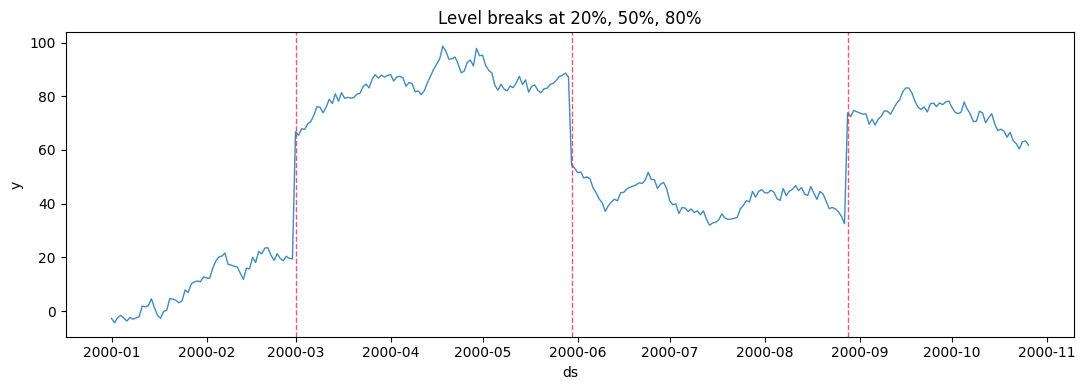
changepoint_level_changes you
passed.
Trend breaks
A trend break changes the slope rather than the level, so the series bends at each changepoint. This example adds them on top of a weekly-seasonal series.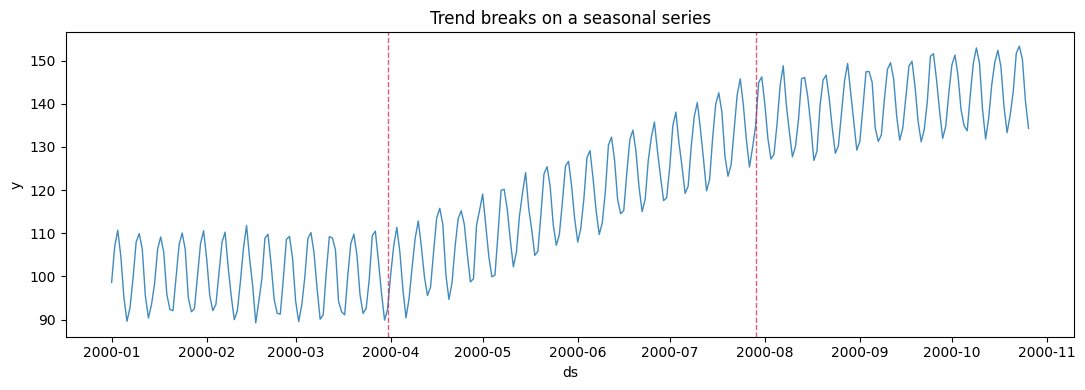
Variance breaks
A variance break changes the noise amplitude — the level and trend are unchanged, but the series becomes calmer or more volatile. These matter for prediction intervals, which should widen after a jump in variance.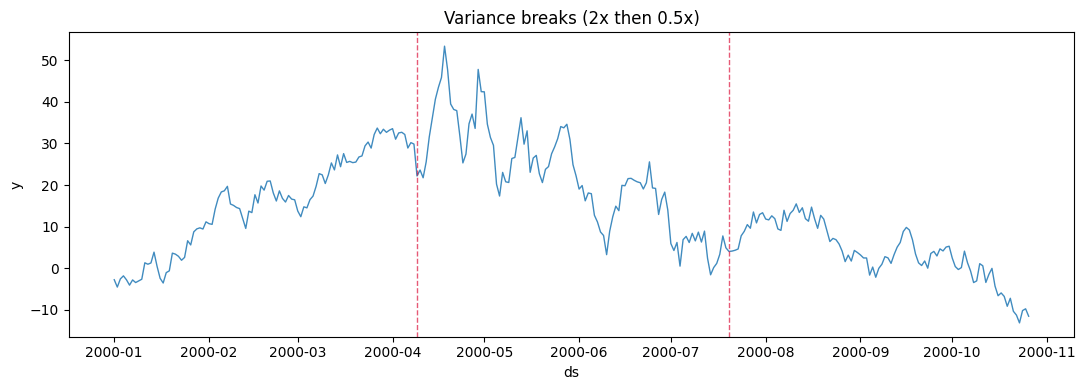
Mixed types and automatic placement
Usechangepoint_type="mixed" to draw a different kind of break at each
changepoint, and omit changepoint_locations to scatter them at random
positions — closer to how breaks arrive in real data.
Multivariate and composed
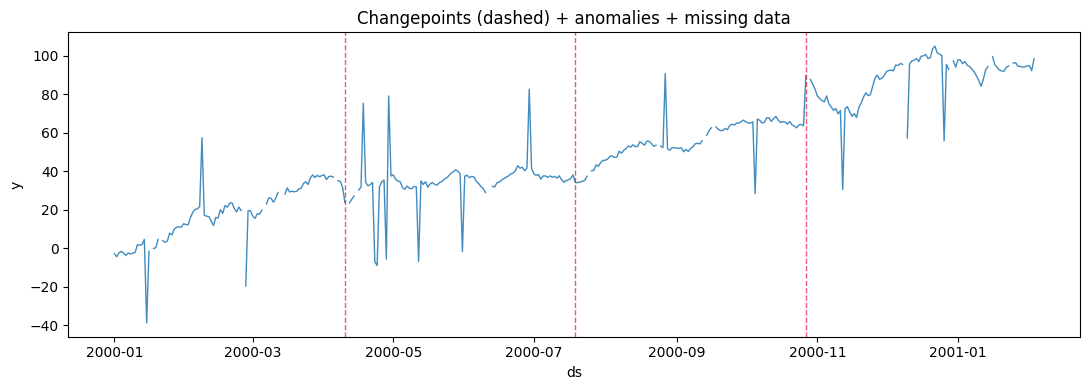
Like all pipeline features, changepoints apply to multivariate generators, and compose with anomalies and missing data for a realistically hard series.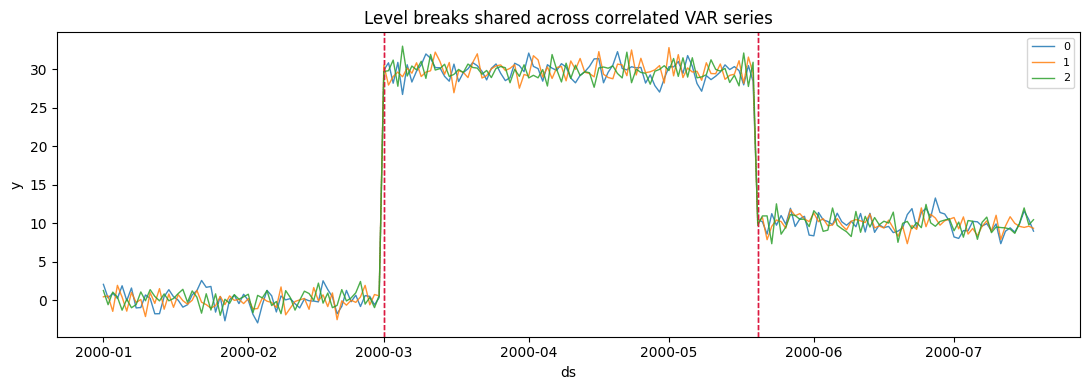
Related capabilities
- Anomalies — transient outliers, as opposed to the sustained regime changes here.
- Missingness — random, block, and seasonal gap patterns.
- All changepoint parameters are documented in the generator reference.