

(p, d, q)(P, D, Q)
specification lets you confirm a model recovers the order you put in, or
build panels with a precise, well-understood dependence structure.
The model An ARIMA(p, d, q) process combinespautoregressive lags,dorders of differencing (for trend / unit roots), andqmoving-average lags; the seasonal part(P, D, Q)repeats that structure at the seasonal period. Set the orders and coefficients to dial in anything from white noise to a strongly seasonal, integrated series.
1. Basic SARIMA(2,1,1)(1,1,1)_7
A SARIMA model with weekly seasonality, suitable for daily data.Model information
Inspect the auto-generated model parameters and polynomial structure.Generate and inspect data
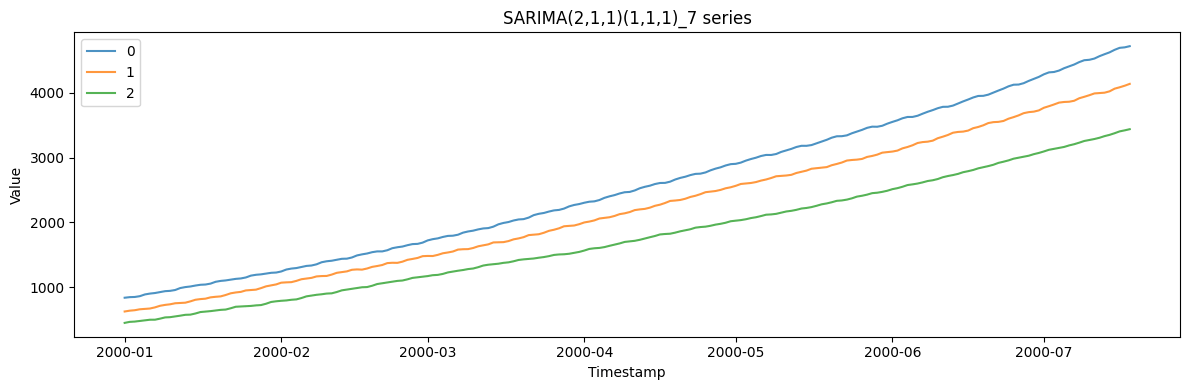
Statistics by series
2. Stationary ARMA(1,1) with custom parameters
A stationary model with no differencing and explicit AR/MA coefficients.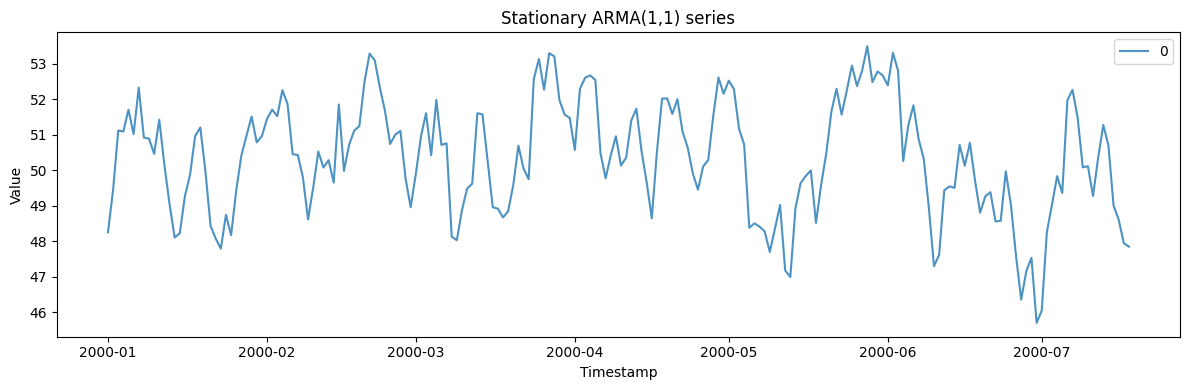
3. Pure seasonal ARIMA(0,0,0)(1,1,1)_12
A purely seasonal model with monthly frequency and 12-month seasonality.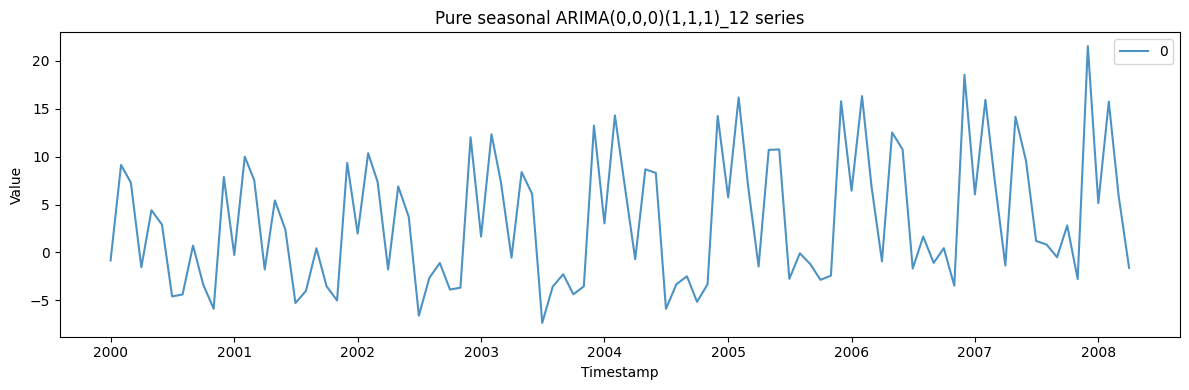
Related generatorsAll orders and coefficients are documented in the generator reference.
- ETS — the exponential-smoothing counterpart for trend and seasonality.
- Seasonal — a simpler fixed seasonal wave without ARMA dynamics.
- Random walk — the special case ARIMA(0, 1, 0).