

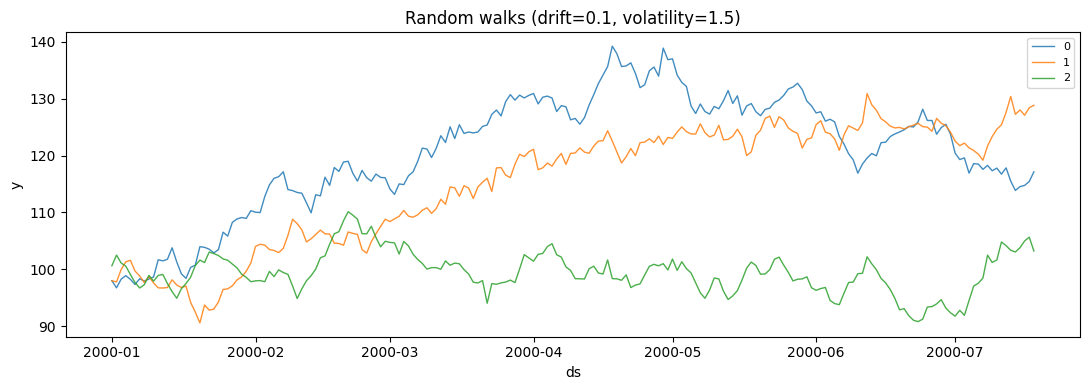
The modelBecause steps accumulate, the variance grows with time — the series has no fixed mean to revert to.
drift() — the constant step added each period; a deterministic trend.volatility() — the standard deviation of the random step.start_value() — where every series begins.
Generate
Instantiate the generator and draw a few series. All outputs are long-format (unique_id, ds, y).
Control the process
drift sets the trend and volatility sets the noise. Holding
volatility fixed, larger drift turns a flat wander into a clear trend.
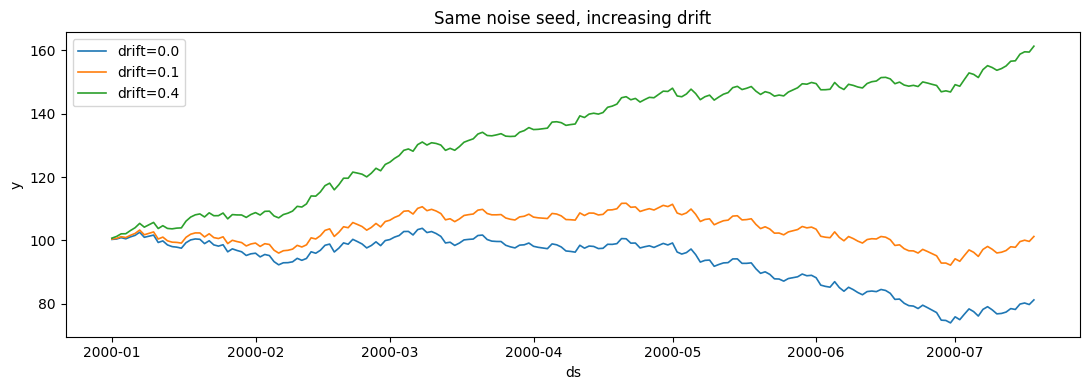
volatility instead and the
paths would keep this trend while wandering further from it.
Statistics by series
Summary statistics vary widely between series even from one generator — a direct consequence of the accumulating, unbounded variance.Related generatorsEvery parameter is documented in the generator reference.
- Geometric Brownian motion — a multiplicative random walk for strictly positive series like prices.
- SARIMA with
d=1— a random walk with added autoregressive/moving-average structure.- Add trend breaks or outliers with the changepoints and anomalies options.