

The model At each step every series is a linear combination of the lastlag_ordervalues of all series, plus correlated innovations.generate(n_series)returns the coupled channels of one system, so the cross-series dynamics are shared rather than independent.
1. VAR(1) with auto-generated stable coefficients
Generate a 3-variable VAR(1) model with automatically generated stable coefficient matrices.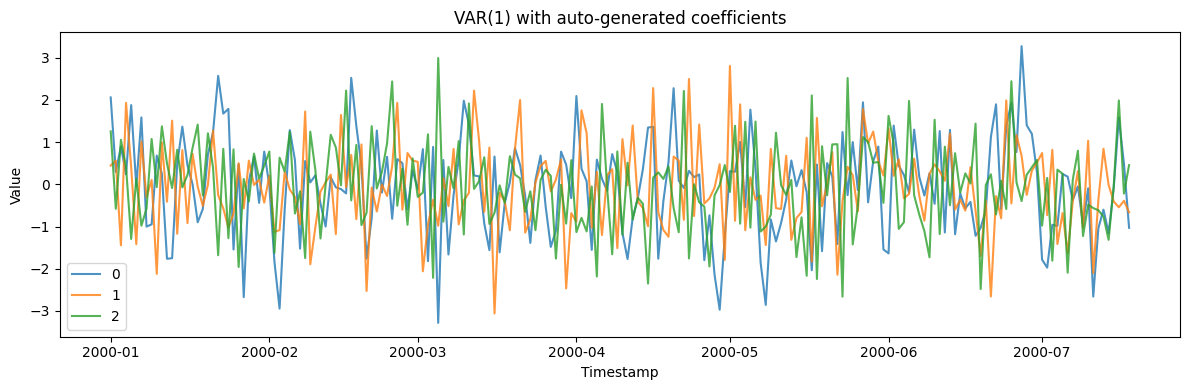
Summary statistics and correlations
2. VAR(1) with custom coefficients (strong cross-effects)
Design a coefficient matrix where each variable depends strongly on the other’s lagged values.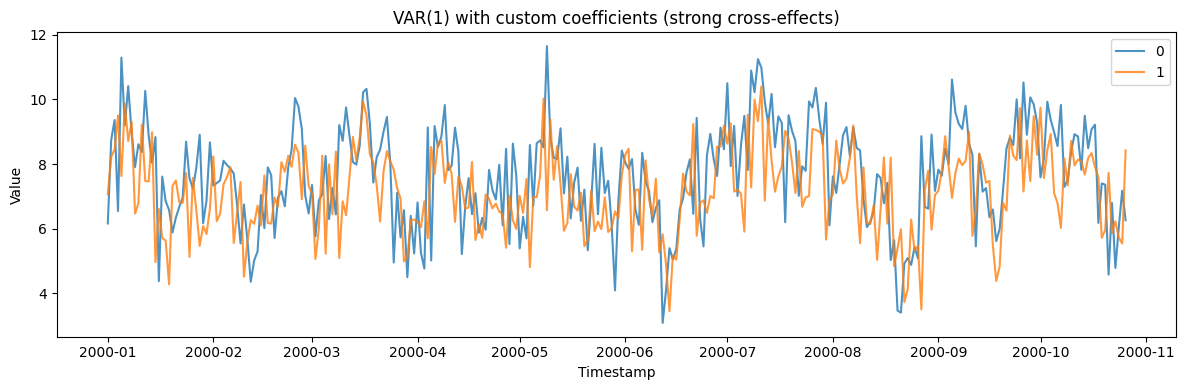
3. Higher-order VAR(3) model
A VAR(3) model uses three lags of each variable, capturing longer-range dependencies.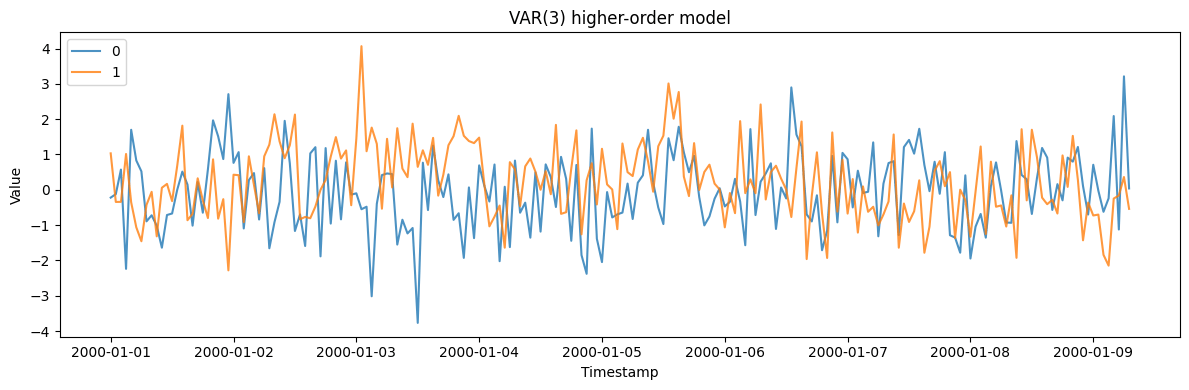
4. VAR with correlated innovations
Specify a custom innovation covariance matrix to add contemporaneous correlation between variables.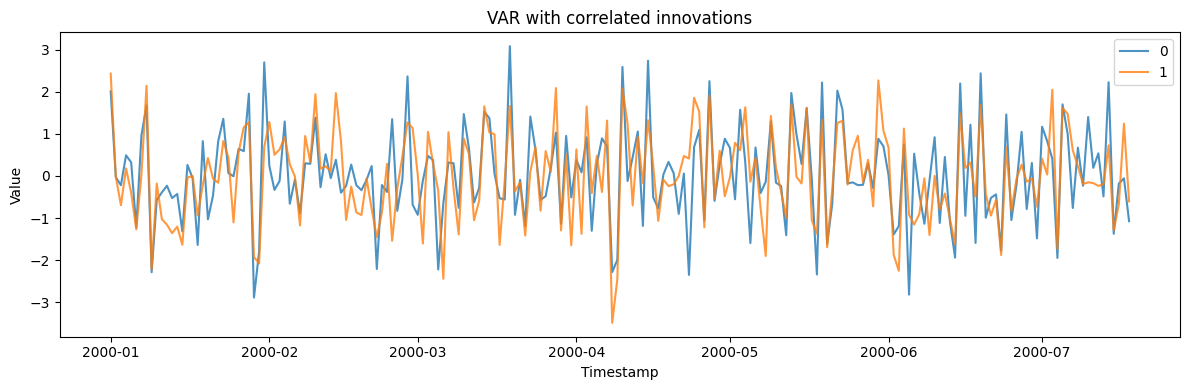
5. Generating multiple VAR series
Generate multiple independent draws of bivariate VAR series.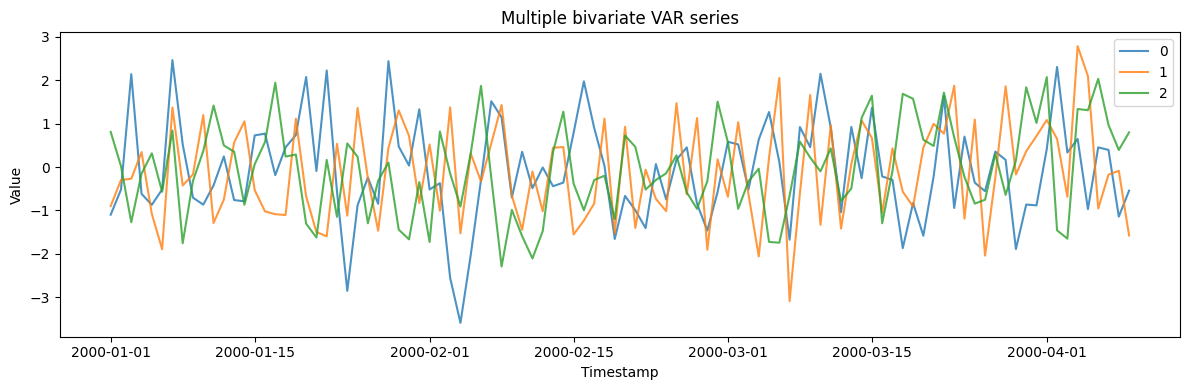
Related generatorsFull parameters are in the generator reference.
- Copula — contemporaneous dependence without temporal dynamics.
- Multivariatize — add coupling to any univariate generator.