> ## Documentation Index
> Fetch the complete documentation index at: https://nixtlaverse.nixtla.io/llms.txt
> Use this file to discover all available pages before exploring further.
> Time-LLM: Reprograms large language models for time series forecasting. Transforms forecasting tasks into language tasks using off-the-shelf LLM backbones.
# Time-LLM
Time-LLM is a reprogramming framework to repurpose LLMs for general time
series forecasting with the backbone language models kept intact. In
other words, it transforms a forecasting task into a “language task”
that can be tackled by an off-the-shelf LLM.
**References**
* [Ming Jin, Shiyu Wang, Lintao Ma, Zhixuan Chu,
James Y. Zhang, Xiaoming Shi, Pin-Yu Chen, Yuxuan Liang, Yuan-Fang Li,
Shirui Pan, Qingsong Wen. “Time-LLM: Time Series Forecasting by
Reprogramming Large Language
Models”](https://arxiv.org/abs/2310.01728)
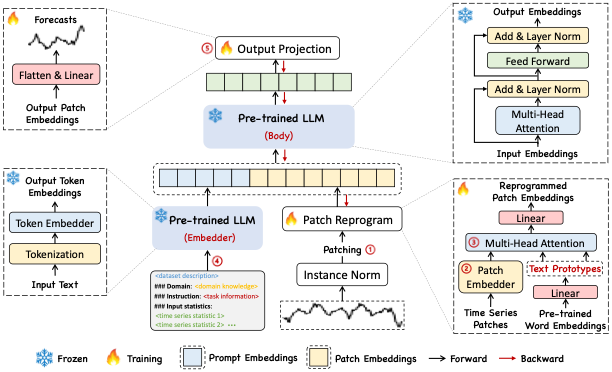 *Figure 1. Time-LLM Architecture.*
## 1. Time-LLM
### Usage example
```python theme={null}
import pandas as pd
import matplotlib.pyplot as plt
from neuralforecast import NeuralForecast
from neuralforecast.models import TimeLLM
from neuralforecast.utils import AirPassengersPanel
Y_train_df = AirPassengersPanel[AirPassengersPanel.ds=AirPassengersPanel['ds'].values[-12]].reset_index(drop=True) # 12 test
prompt_prefix = "The dataset contains data on monthly air passengers. There is a yearly seasonality"
timellm = TimeLLM(h=12,
input_size=36,
llm='openai-community/gpt2',
prompt_prefix=prompt_prefix,
batch_size=16,
valid_batch_size=16,
windows_batch_size=16)
nf = NeuralForecast(
models=[timellm],
freq='ME'
)
nf.fit(df=Y_train_df, val_size=12)
forecasts = nf.predict(futr_df=Y_test_df)
```
## 2. Auxiliary Functions
### `ReprogrammingLayer`
```python theme={null}
ReprogrammingLayer(
d_model, n_heads, d_keys=None, d_llm=None, attention_dropout=0.1
)
```
Bases:
*Figure 1. Time-LLM Architecture.*
## 1. Time-LLM
### Usage example
```python theme={null}
import pandas as pd
import matplotlib.pyplot as plt
from neuralforecast import NeuralForecast
from neuralforecast.models import TimeLLM
from neuralforecast.utils import AirPassengersPanel
Y_train_df = AirPassengersPanel[AirPassengersPanel.ds=AirPassengersPanel['ds'].values[-12]].reset_index(drop=True) # 12 test
prompt_prefix = "The dataset contains data on monthly air passengers. There is a yearly seasonality"
timellm = TimeLLM(h=12,
input_size=36,
llm='openai-community/gpt2',
prompt_prefix=prompt_prefix,
batch_size=16,
valid_batch_size=16,
windows_batch_size=16)
nf = NeuralForecast(
models=[timellm],
freq='ME'
)
nf.fit(df=Y_train_df, val_size=12)
forecasts = nf.predict(futr_df=Y_test_df)
```
## 2. Auxiliary Functions
### `ReprogrammingLayer`
```python theme={null}
ReprogrammingLayer(
d_model, n_heads, d_keys=None, d_llm=None, attention_dropout=0.1
)
```
Bases: [Module](#torch.nn.Module)
ReprogrammingLayer
### `FlattenHead`
```python theme={null}
FlattenHead(n_vars, nf, target_window, head_dropout=0)
```
Bases: [Module](#torch.nn.Module)
FlattenHead
### `PatchEmbedding`
```python theme={null}
PatchEmbedding(d_model, patch_len, stride, dropout)
```
Bases: [Module](#torch.nn.Module)
PatchEmbedding
### `TokenEmbedding`
```python theme={null}
TokenEmbedding(c_in, d_model)
```
Bases: [Module](#torch.nn.Module)
TokenEmbedding
### `ReplicationPad1d`
```python theme={null}
ReplicationPad1d(padding)
```
Bases: [Module](#torch.nn.Module)
ReplicationPad1d