> ## Documentation Index
> Fetch the complete documentation index at: https://nixtlaverse.nixtla.io/llms.txt
> Use this file to discover all available pages before exploring further.
> NHITS: Neural Hierarchical Interpolation for Time Series. MLP architecture with multi-rate processing for long-horizon forecasting, 50x faster than Informer.
# NHITS
Long-horizon forecasting is challenging because of the *volatility* of
the predictions and the *computational complexity*. To solve this
problem we created the Neural Hierarchical Interpolation for Time Series
(NHITS).
[`NHITS`](./models.nhits.html#nhits)
builds upon
[`NBEATS`](./models.nbeats.html#nbeats)
and specializes its partial outputs in the different frequencies of the
time series through hierarchical interpolation and multi-rate input
processing. On the long-horizon forecasting task
[`NHITS`](./models.nhits.html#nhits)
improved accuracy by 25% on AAAI’s best paper award the
[`Informer`](./models.informer.html#informer),
while being 50x faster.
The model is composed of several MLPs with ReLU non-linearities. Blocks
are connected via doubly residual stacking principle with the backcast
$\mathbf{\tilde{y}}_{t-L:t,l}$ and forecast
$\mathbf{\hat{y}}_{t+1:t+H,l}$ outputs of the l-th block. Multi-rate
input pooling, hierarchical interpolation and backcast residual
connections together induce the specialization of the additive
predictions in different signal bands, reducing memory footprint and
computational time, thus improving the architecture parsimony and
accuracy.
**References**
* [Boris N. Oreshkin, Dmitri Carpov, Nicolas Chapados,
Yoshua Bengio (2019). “N-BEATS: Neural basis expansion analysis for
interpretable time series
forecasting”.](https://arxiv.org/abs/1905.10437)
* [Cristian Challu,
Kin G. Olivares, Boris N. Oreshkin, Federico Garza, Max
Mergenthaler-Canseco, Artur Dubrawski (2023). “NHITS: Neural
Hierarchical Interpolation for Time Series Forecasting”. Accepted at the
Thirty-Seventh AAAI Conference on Artificial
Intelligence.](https://arxiv.org/abs/2201.12886)
* [Zhou, H.; Zhang,
S.; Peng, J.; Zhang, S.; Li, J.; Xiong, H.; and Zhang, W. (2020).
“Informer: Beyond Efficient Transformer for Long Sequence Time-Series
Forecasting”. Association for the Advancement of Artificial Intelligence
Conference 2021 (AAAI 2021).](https://arxiv.org/abs/2012.07436)
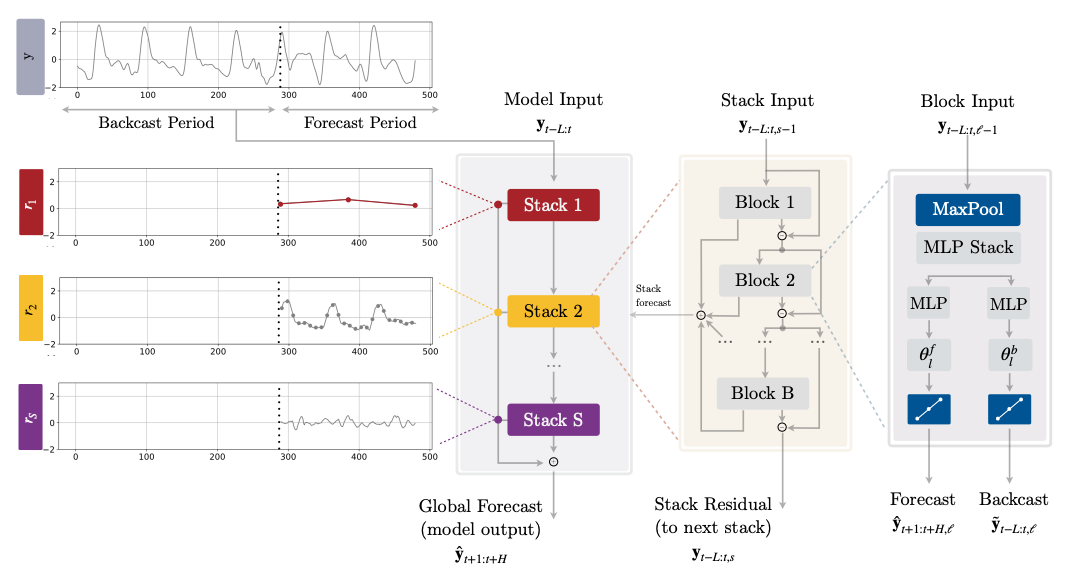 *Figure 1. Neural Hierarchical
Interpolation for Time Series (NHITS).*
## NHITS
### `NHITS`
```python theme={null}
NHITS(
h,
input_size,
futr_exog_list=None,
hist_exog_list=None,
stat_exog_list=None,
exclude_insample_y=False,
stack_types=["identity", "identity", "identity"],
n_blocks=[1, 1, 1],
mlp_units=3 * [[512, 512]],
n_pool_kernel_size=[2, 2, 1],
n_freq_downsample=[4, 2, 1],
pooling_mode="MaxPool1d",
interpolation_mode="linear",
dropout_prob_theta=0.0,
activation="ReLU",
loss=MAE(),
valid_loss=None,
max_steps=1000,
learning_rate=0.001,
num_lr_decays=3,
early_stop_patience_steps=-1,
val_monitor="ptl/val_loss",
val_check_steps=100,
batch_size=32,
valid_batch_size=None,
windows_batch_size=1024,
inference_windows_batch_size=-1,
start_padding_enabled=False,
training_data_availability_threshold=0.0,
step_size=1,
scaler_type="identity",
random_seed=1,
drop_last_loader=False,
alias=None,
optimizer=None,
optimizer_kwargs=None,
lr_scheduler=None,
lr_scheduler_kwargs=None,
dataloader_kwargs=None,
**trainer_kwargs
)
```
Bases:
*Figure 1. Neural Hierarchical
Interpolation for Time Series (NHITS).*
## NHITS
### `NHITS`
```python theme={null}
NHITS(
h,
input_size,
futr_exog_list=None,
hist_exog_list=None,
stat_exog_list=None,
exclude_insample_y=False,
stack_types=["identity", "identity", "identity"],
n_blocks=[1, 1, 1],
mlp_units=3 * [[512, 512]],
n_pool_kernel_size=[2, 2, 1],
n_freq_downsample=[4, 2, 1],
pooling_mode="MaxPool1d",
interpolation_mode="linear",
dropout_prob_theta=0.0,
activation="ReLU",
loss=MAE(),
valid_loss=None,
max_steps=1000,
learning_rate=0.001,
num_lr_decays=3,
early_stop_patience_steps=-1,
val_monitor="ptl/val_loss",
val_check_steps=100,
batch_size=32,
valid_batch_size=None,
windows_batch_size=1024,
inference_windows_batch_size=-1,
start_padding_enabled=False,
training_data_availability_threshold=0.0,
step_size=1,
scaler_type="identity",
random_seed=1,
drop_last_loader=False,
alias=None,
optimizer=None,
optimizer_kwargs=None,
lr_scheduler=None,
lr_scheduler_kwargs=None,
dataloader_kwargs=None,
**trainer_kwargs
)
```
Bases: [BaseModel](#neuralforecast.common._base_model.BaseModel)
NHITS
The Neural Hierarchical Interpolation for Time Series (NHITS), is an MLP-based deep
neural architecture with backward and forward residual links. NHITS tackles volatility and
memory complexity challenges, by locally specializing its sequential predictions into
the signals frequencies with hierarchical interpolation and pooling.
**Parameters:**
| Name | Type | Description | Default |
| -------------------------------------- | ------------------------------------------------------------------------------- | ------------------------------------------------------------------------------------------------------------------------------------------------------------------------------------------------------------------------------------------------------------------------------ | -------------------------------------------------- |
| `h` | [int](#int) | Forecast horizon. | *required* |
| `input_size` | [int](#int) | autorregresive inputs size, y=\[1,2,3,4] input\_size=2 -> y\_\[t-2:t]=\[1,2]. | *required* |
| `futr_exog_list` | str list | future exogenous columns. | None |
| `hist_exog_list` | str list | historic exogenous columns. | None |
| `stat_exog_list` | str list | static exogenous columns. | None |
| `exclude_insample_y` | [bool](#bool) | the model skips the autoregressive features y\[t-input\_size:t] if True. | False |
| `stack_types` | [List](#List)\[[str](#str)] | stacks list in the form N \* \['identity'], to be deprecated in favor of `n_stacks`. Note that len(stack\_types)=len(n\_freq\_downsample)=len(n\_pool\_kernel\_size). | \['identity', 'identity', 'identity'] |
| `n_blocks` | [List](#List)\[[int](#int)] | Number of blocks for each stack. Note that len(n\_blocks) = len(stack\_types). | \[1, 1, 1] |
| `mlp_units` | [List](#List)\[[List](#List)\[[int](#int)]] | Structure of hidden layers for each stack type. Each internal list should contain the number of units of each hidden layer. Note that len(n\_hidden) = len(stack\_types). | 3 \* \[\[512, 512]] |
| `n_pool_kernel_size` | [List](#List)\[[int](#int)] | list with the size of the windows to take a max/avg over. Note that len(stack\_types)=len(n\_freq\_downsample)=len(n\_pool\_kernel\_size). | \[2, 2, 1] |
| `n_freq_downsample` | [List](#List)\[[int](#int)] | list with the stack's coefficients (inverse expressivity ratios). Note that len(stack\_types)=len(n\_freq\_downsample)=len(n\_pool\_kernel\_size). | \[4, 2, 1] |
| `pooling_mode` | [str](#str) | input pooling module from \['MaxPool1d', 'AvgPool1d']. | 'MaxPool1d' |
| `interpolation_mode` | [str](#str) | interpolation basis from \['linear', 'nearest', 'cubic']. | 'linear' |
| `dropout_prob_theta` | [float](#float) | Float between (0, 1). Dropout for NHITS basis. | 0.0 |
| `activation` | [str](#str) | activation from \['ReLU', 'Softplus', 'Tanh', 'SELU', 'LeakyReLU', 'PReLU', 'Sigmoid']. | 'ReLU' |
| `learning_rate` | [float](#float) | Learning rate between (0, 1). | 0.001 |
| `num_lr_decays` | [int](#int) | Number of learning rate decays, evenly distributed across max\_steps. | 3 |
| `early_stop_patience_steps` | [int](#int) | Number of validation iterations before early stopping. | -1 |
| `val_monitor` | [str](#str) | metric to monitor for early stopping. Valid options: "ptl/val\_loss", "valid\_loss", "train\_loss". Default: "ptl/val\_loss". | 'ptl/val\_loss' |
| `val_check_steps` | [int](#int) | Number of training steps between every validation loss check. | 100 |
| `batch_size` | [int](#int) | number of different series in each batch. | 32 |
| `valid_batch_size` | [int](#int) | number of different series in each validation and test batch, if None uses batch\_size. | None |
| `windows_batch_size` | [int](#int) | number of windows to sample in each training batch, default uses all. | 1024 |
| `inference_windows_batch_size` | [int](#int) | number of windows to sample in each inference batch, -1 uses all. | -1 |
| `start_padding_enabled` | [bool](#bool) | if True, the model will pad the time series with zeros at the beginning, by input size. | False |
| `training_data_availability_threshold` | [Union](#Union)\[[float](#float), [List](#List)\[[float](#float)]] | minimum fraction of valid data points required for training windows. Single float applies to both insample and outsample; list of two floats specifies \[insample\_fraction, outsample\_fraction]. Default 0.0 allows windows with only 1 valid data point (current behavior). | 0.0 |
| `step_size` | [int](#int) | step size between each window of temporal data. | 1 |
| `scaler_type` | [str](#str) | type of scaler for temporal inputs normalization see [temporal scalers](https://github.com/Nixtla/neuralforecast/blob/main/neuralforecast/common/_scalers.py). | 'identity' |
| `random_seed` | [int](#int) | random\_seed for pytorch initializer and numpy generators. | 1 |
| `drop_last_loader` | [bool](#bool) | if True `TimeSeriesDataLoader` drops last non-full batch. | False |
| `alias` | [str](#str) | optional, Custom name of the model. | None |
| `optimizer` | Subclass of 'torch.optim.Optimizer' | optional, user specified optimizer instead of the default choice (Adam). | None |
| `optimizer_kwargs` | [dict](#dict) | optional, list of parameters used by the user specified `optimizer`. | None |
| `lr_scheduler` | Subclass of 'torch.optim.lr\_scheduler.LRScheduler' | optional, user specified lr\_scheduler instead of the default choice (StepLR). | None |
| `lr_scheduler_kwargs` | [dict](#dict) | optional, list of parameters used by the user specified `lr_scheduler`. | None |
| `dataloader_kwargs` | [dict](#dict) | optional, list of parameters passed into the PyTorch Lightning dataloader by the `TimeSeriesDataLoader`. | None |
| `**trainer_kwargs` | [int](#int) | keyword trainer arguments inherited from [PyTorch Lighning's trainer](https://pytorch-lightning.readthedocs.io/en/stable/api/pytorch_lightning.trainer.trainer.Trainer.html?highlight=trainer). | {} |
References
* [Cristian Challu, Kin G. Olivares, Boris N. Oreshkin, Federico Garza, Max Mergenthaler-Canseco, Artur Dubrawski (2023). "NHITS: Neural Hierarchical Interpolation for Time Series Forecasting". Accepted at the Thirty-Seventh AAAI Conference on Artificial Intelligence.](https://arxiv.org/abs/2201.12886)
#### `NHITS.fit`
```python theme={null}
fit(
dataset, val_size=0, test_size=0, random_seed=None, distributed_config=None
)
```
Fit.
The `fit` method, optimizes the neural network's weights using the
initialization parameters (`learning_rate`, `windows_batch_size`, ...)
and the `loss` function as defined during the initialization.
Within `fit` we use a PyTorch Lightning `Trainer` that
inherits the initialization's `self.trainer_kwargs`, to customize
its inputs, see [PL's trainer arguments](https://pytorch-lightning.readthedocs.io/en/stable/api/pytorch_lightning.trainer.trainer.Trainer.html?highlight=trainer).
The method is designed to be compatible with SKLearn-like classes
and in particular to be compatible with the StatsForecast library.
By default the `model` is not saving training checkpoints to protect
disk memory, to get them change `enable_checkpointing=True` in `__init__`.
**Parameters:**
| Name | Type | Description | Default |
| ------------- | ---------------------------------------------------- | -------------------------------------------------------------------------------------- | ----------------- |
| `dataset` | [TimeSeriesDataset](#TimeSeriesDataset) | NeuralForecast's `TimeSeriesDataset`, see [documentation](./tsdataset.html). | *required* |
| `val_size` | [int](#int) | Validation size for temporal cross-validation. | 0 |
| `random_seed` | [int](#int) | Random seed for pytorch initializer and numpy generators, overwrites model.**init**'s. | None |
| `test_size` | [int](#int) | Test size for temporal cross-validation. | 0 |
**Returns:**
| Type | Description |
| ---- | ----------- |
| None | |
#### `NHITS.predict`
```python theme={null}
predict(
dataset,
test_size=None,
step_size=1,
random_seed=None,
quantiles=None,
h=None,
explainer_config=None,
**data_module_kwargs
)
```
Predict.
Neural network prediction with PL's `Trainer` execution of `predict_step`.
**Parameters:**
| Name | Type | Description | Default |
| ---------------------- | ---------------------------------------------------- | ------------------------------------------------------------------------------------------------------------------------------------------------------ | ----------------- |
| `dataset` | [TimeSeriesDataset](#TimeSeriesDataset) | NeuralForecast's `TimeSeriesDataset`, see [documentation](./tsdataset.html). | *required* |
| `test_size` | [int](#int) | Test size for temporal cross-validation. | None |
| `step_size` | [int](#int) | Step size between each window. | 1 |
| `random_seed` | [int](#int) | Random seed for pytorch initializer and numpy generators, overwrites model.**init**'s. | None |
| `quantiles` | [list](#list) | Target quantiles to predict. | None |
| `h` | [int](#int) | Prediction horizon, if None, uses the model's fitted horizon. Defaults to None. | None |
| `explainer_config` | [dict](#dict) | configuration for explanations. | None |
| `**data_module_kwargs` | [dict](#dict) | PL's TimeSeriesDataModule args, see [documentation](https://pytorch-lightning.readthedocs.io/en/1.6.1/extensions/datamodules.html#using-a-datamodule). | {} |
**Returns:**
| Type | Description |
| ---- | ----------- |
| None | |
### Usage Example
```python theme={null}
import pandas as pd
import matplotlib.pyplot as plt
from neuralforecast import NeuralForecast
from neuralforecast.models import NHITS
from neuralforecast.losses.pytorch import DistributionLoss
from neuralforecast.utils import AirPassengersPanel, AirPassengersStatic
Y_train_df = AirPassengersPanel[AirPassengersPanel.ds=AirPassengersPanel['ds'].values[-12]].reset_index(drop=True) # 12 test
model = NHITS(h=12,
input_size=24,
loss=DistributionLoss(distribution='StudentT', level=[80, 90], return_params=True),
stat_exog_list=['airline1'],
futr_exog_list=['trend'],
n_freq_downsample=[2, 1, 1],
scaler_type='robust',
max_steps=200,
early_stop_patience_steps=2,
inference_windows_batch_size=1,
val_check_steps=10,
learning_rate=1e-3)
fcst = NeuralForecast(models=[model], freq='ME')
fcst.fit(df=Y_train_df, static_df=AirPassengersStatic, val_size=12)
forecasts = fcst.predict(futr_df=Y_test_df)
# Plot quantile predictions
Y_hat_df = forecasts.reset_index(drop=False).drop(columns=['unique_id','ds'])
plot_df = pd.concat([Y_test_df, Y_hat_df], axis=1)
plot_df = pd.concat([Y_train_df, plot_df])
plot_df = plot_df[plot_df.unique_id=='Airline1'].drop('unique_id', axis=1)
plt.plot(plot_df['ds'], plot_df['y'], c='black', label='True')
plt.plot(plot_df['ds'], plot_df['NHITS-median'], c='blue', label='median')
plt.fill_between(x=plot_df['ds'][-12:],
y1=plot_df['NHITS-lo-90'][-12:].values,
y2=plot_df['NHITS-hi-90'][-12:].values,
alpha=0.4, label='level 90')
plt.legend()
plt.grid()
plt.plot()
```