> ## Documentation Index
> Fetch the complete documentation index at: https://nixtlaverse.nixtla.io/llms.txt
> Use this file to discover all available pages before exploring further.

> MLPMultivariate: Multi-Layer Perceptron for joint multivariate forecasting. Predicts all time series simultaneously with shared feedforward neural network layers.

# MLPMultivariate

One of the simplest neural architectures are Multi Layer Perceptrons (`MLP`)
composed of stacked Fully Connected Neural Networks trained with
backpropagation. Each node in the architecture is capable of modeling
non-linear relationships granted by their activation functions. Novel
activations like Rectified Linear Units (`ReLU`) have greatly improved the
ability to fit deeper networks overcoming gradient vanishing problems that
were associated with `Sigmoid` and `TanH` activations. For the forecasting
task the last layer is changed to follow a auto-regression problem. This
version is multivariate, indicating that it will predict all time series of
the forecasting problem jointly.

**References**

-[Rosenblatt, F. (1958). "The perceptron: A probabilistic model for information storage and organization in the brain."](https://psycnet.apa.org/record/1959-09865-001)
-[Fukushima, K. (1975). "Cognitron: A self-organizing multilayered neural network."](https://pascal-francis.inist.fr/vibad/index.php?action=getRecordDetail\&idt=PASCAL7750396723)
-[Vinod Nair, Geoffrey E. Hinton (2010). "Rectified Linear Units Improve Restricted Boltzmann Machines"](https://www.cs.toronto.edu/~fritz/absps/reluICML.pdf)
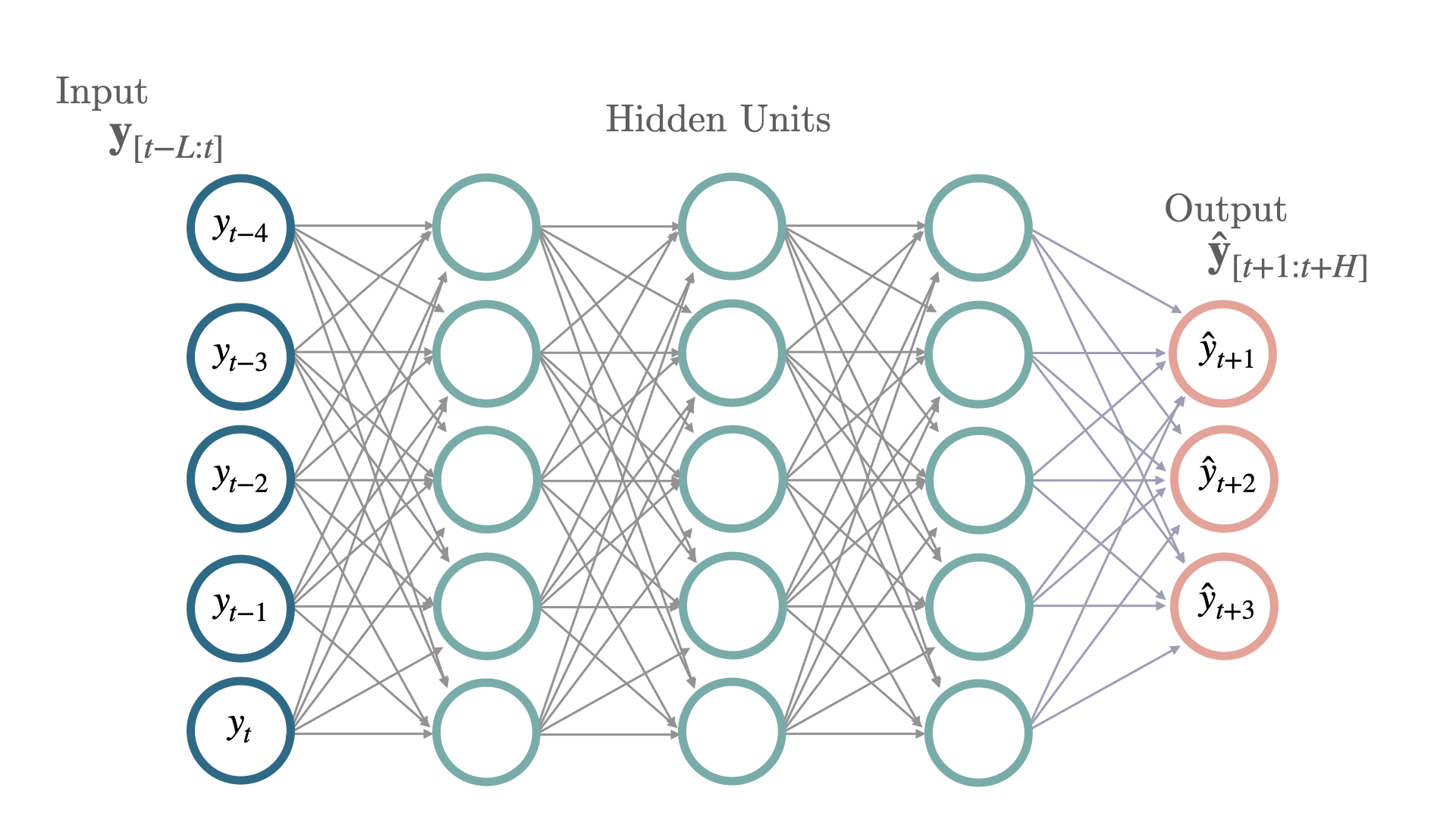
<img src="https://mintcdn.com/nixtla/ldwvWbCUC65OBWwN/neuralforecast/imgs_models/mlp.png?fit=max&auto=format&n=ldwvWbCUC65OBWwN&q=85&s=1a0c39df0b33bb20b5f7f54a4f18bbbe" alt="Figure 1. Three layer MLP with autorregresive inputs." width="1920" height="1080" data-path="neuralforecast/imgs_models/mlp.png" />

*Figure 1. Three layer MLP with autorregresive inputs.*

## MLPMultivariate

### `MLPMultivariate`

```python theme={null}
MLPMultivariate(
    h,
    input_size,
    n_series,
    stat_exog_list=None,
    hist_exog_list=None,
    futr_exog_list=None,
    exclude_insample_y=False,
    num_layers=2,
    hidden_size=1024,
    loss=MAE(),
    valid_loss=None,
    max_steps=1000,
    learning_rate=0.001,
    num_lr_decays=-1,
    early_stop_patience_steps=-1,
    val_monitor="ptl/val_loss",
    val_check_steps=100,
    batch_size=32,
    valid_batch_size=None,
    windows_batch_size=32,
    inference_windows_batch_size=32,
    start_padding_enabled=False,
    training_data_availability_threshold=0.0,
    step_size=1,
    scaler_type="identity",
    random_seed=1,
    drop_last_loader=False,
    alias=None,
    optimizer=None,
    optimizer_kwargs=None,
    lr_scheduler=None,
    lr_scheduler_kwargs=None,
    dataloader_kwargs=None,
    **trainer_kwargs
)
```

Bases: <code>[BaseModel](#neuralforecast.common._base_model.BaseModel)</code>

MLPMultivariate

Simple Multi Layer Perceptron architecture (MLP) for multivariate forecasting.
This deep neural network has constant units through its layers, each with
ReLU non-linearities, it is trained using ADAM stochastic gradient descent.
The network accepts static, historic and future exogenous data, flattens
the inputs and learns fully connected relationships against the target variables.

**Parameters:**

| Name                                   | Type                                                                            | Description                                                                                                                                                                                                                                                                    | Default                                                  |
| -------------------------------------- | ------------------------------------------------------------------------------- | ------------------------------------------------------------------------------------------------------------------------------------------------------------------------------------------------------------------------------------------------------------------------------ | -------------------------------------------------------- |
| `h`                                    | <code>[int](#int)</code>                                                        | forecast horizon.                                                                                                                                                                                                                                                              | *required*                                               |
| `input_size`                           | <code>[int](#int)</code>                                                        | considered autorregresive inputs (lags), y=\[1,2,3,4] input\_size=2 -> lags=\[1,2].                                                                                                                                                                                            | *required*                                               |
| `n_series`                             | <code>[int](#int)</code>                                                        | number of time-series.                                                                                                                                                                                                                                                         | *required*                                               |
| `stat_exog_list`                       | <code>str list</code>                                                           | static exogenous columns.                                                                                                                                                                                                                                                      | <code>None</code>                                        |
| `hist_exog_list`                       | <code>str list</code>                                                           | historic exogenous columns.                                                                                                                                                                                                                                                    | <code>None</code>                                        |
| `futr_exog_list`                       | <code>str list</code>                                                           | future exogenous columns.                                                                                                                                                                                                                                                      | <code>None</code>                                        |
| `num_layers`                           | <code>[int](#int)</code>                                                        | number of layers for the MLP.                                                                                                                                                                                                                                                  | <code>2</code>                                           |
| `hidden_size`                          | <code>[int](#int)</code>                                                        | number of units for each layer of the MLP.                                                                                                                                                                                                                                     | <code>1024</code>                                        |
| `loss`                                 | <code>PyTorch module</code>                                                     | instantiated train loss class from [losses collection](./losses.pytorch.html).                                                                                                                                                                                                 | <code>[MAE](#neuralforecast.losses.pytorch.MAE)()</code> |
| `valid_loss`                           | <code>PyTorch module</code>                                                     | instantiated valid loss class from [losses collection](./losses.pytorch.html).                                                                                                                                                                                                 | <code>None</code>                                        |
| `max_steps`                            | <code>[int](#int)</code>                                                        | maximum number of training steps.                                                                                                                                                                                                                                              | <code>1000</code>                                        |
| `learning_rate`                        | <code>[float](#float)</code>                                                    | Learning rate between (0, 1).                                                                                                                                                                                                                                                  | <code>0.001</code>                                       |
| `num_lr_decays`                        | <code>[int](#int)</code>                                                        | Number of learning rate decays, evenly distributed across max\_steps.                                                                                                                                                                                                          | <code>-1</code>                                          |
| `early_stop_patience_steps`            | <code>[int](#int)</code>                                                        | Number of validation iterations before early stopping.                                                                                                                                                                                                                         | <code>-1</code>                                          |
| `val_monitor`                          | <code>[str](#str)</code>                                                        | metric to monitor for early stopping. Valid options: "ptl/val\_loss", "valid\_loss", "train\_loss". Default: "ptl/val\_loss".                                                                                                                                                  | <code>'ptl/val\_loss'</code>                             |
| `val_check_steps`                      | <code>[int](#int)</code>                                                        | Number of training steps between every validation loss check.                                                                                                                                                                                                                  | <code>100</code>                                         |
| `batch_size`                           | <code>[int](#int)</code>                                                        | number of different series in each batch.                                                                                                                                                                                                                                      | <code>32</code>                                          |
| `valid_batch_size`                     | <code>[int](#int)</code>                                                        | number of different series in each validation and test batch, if None uses batch\_size.                                                                                                                                                                                        | <code>None</code>                                        |
| `windows_batch_size`                   | <code>[int](#int)</code>                                                        | number of windows to sample in each training batch, default uses all.                                                                                                                                                                                                          | <code>32</code>                                          |
| `inference_windows_batch_size`         | <code>[int](#int)</code>                                                        | number of windows to sample in each inference batch, -1 uses all.                                                                                                                                                                                                              | <code>32</code>                                          |
| `start_padding_enabled`                | <code>[bool](#bool)</code>                                                      | if True, the model will pad the time series with zeros at the beginning, by input size.                                                                                                                                                                                        | <code>False</code>                                       |
| `training_data_availability_threshold` | <code>[Union](#Union)\[[float](#float), [List](#List)\[[float](#float)]]</code> | minimum fraction of valid data points required for training windows. Single float applies to both insample and outsample; list of two floats specifies \[insample\_fraction, outsample\_fraction]. Default 0.0 allows windows with only 1 valid data point (current behavior). | <code>0.0</code>                                         |
| `step_size`                            | <code>[int](#int)</code>                                                        | step size between each window of temporal data.                                                                                                                                                                                                                                | <code>1</code>                                           |
| `scaler_type`                          | <code>[str](#str)</code>                                                        | type of scaler for temporal inputs normalization see [temporal scalers](https://github.com/Nixtla/neuralforecast/blob/main/neuralforecast/common/_scalers.py).                                                                                                                 | <code>'identity'</code>                                  |
| `random_seed`                          | <code>[int](#int)</code>                                                        | random\_seed for pytorch initializer and numpy generators.                                                                                                                                                                                                                     | <code>1</code>                                           |
| `drop_last_loader`                     | <code>[bool](#bool)</code>                                                      | if True `TimeSeriesDataLoader` drops last non-full batch.                                                                                                                                                                                                                      | <code>False</code>                                       |
| `alias`                                | <code>[str](#str)</code>                                                        | optional, Custom name of the model.                                                                                                                                                                                                                                            | <code>None</code>                                        |
| `optimizer`                            | <code>Subclass of 'torch.optim.Optimizer'</code>                                | optional, user specified optimizer instead of the default choice (Adam).                                                                                                                                                                                                       | <code>None</code>                                        |
| `optimizer_kwargs`                     | <code>[dict](#dict)</code>                                                      | optional, list of parameters used by the user specified `optimizer`.                                                                                                                                                                                                           | <code>None</code>                                        |
| `lr_scheduler`                         | <code>Subclass of 'torch.optim.lr\_scheduler.LRScheduler'</code>                | optional, user specified lr\_scheduler instead of the default choice (StepLR).                                                                                                                                                                                                 | <code>None</code>                                        |
| `lr_scheduler_kwargs`                  | <code>[dict](#dict)</code>                                                      | optional, list of parameters used by the user specified `lr_scheduler`.                                                                                                                                                                                                        | <code>None</code>                                        |
| `dataloader_kwargs`                    | <code>[dict](#dict)</code>                                                      | optional, list of parameters passed into the PyTorch Lightning dataloader by the `TimeSeriesDataLoader`.                                                                                                                                                                       | <code>None</code>                                        |
| `**trainer_kwargs`                     | <code>[int](#int)</code>                                                        | keyword trainer arguments inherited from [PyTorch Lighning's trainer](https://pytorch-lightning.readthedocs.io/en/stable/api/pytorch_lightning.trainer.trainer.Trainer.html?highlight=trainer).                                                                                | <code>{}</code>                                          |

#### `MLPMultivariate.fit`

```python theme={null}
fit(
    dataset, val_size=0, test_size=0, random_seed=None, distributed_config=None
)
```

Fit.

The `fit` method, optimizes the neural network's weights using the
initialization parameters (`learning_rate`, `windows_batch_size`, ...)
and the `loss` function as defined during the initialization.
Within `fit` we use a PyTorch Lightning `Trainer` that
inherits the initialization's `self.trainer_kwargs`, to customize
its inputs, see [PL's trainer arguments](https://pytorch-lightning.readthedocs.io/en/stable/api/pytorch_lightning.trainer.trainer.Trainer.html?highlight=trainer).

The method is designed to be compatible with SKLearn-like classes
and in particular to be compatible with the StatsForecast library.

By default the `model` is not saving training checkpoints to protect
disk memory, to get them change `enable_checkpointing=True` in `__init__`.

**Parameters:**

| Name          | Type                                                 | Description                                                                            | Default           |
| ------------- | ---------------------------------------------------- | -------------------------------------------------------------------------------------- | ----------------- |
| `dataset`     | <code>[TimeSeriesDataset](#TimeSeriesDataset)</code> | NeuralForecast's `TimeSeriesDataset`, see [documentation](./tsdataset.html).           | *required*        |
| `val_size`    | <code>[int](#int)</code>                             | Validation size for temporal cross-validation.                                         | <code>0</code>    |
| `random_seed` | <code>[int](#int)</code>                             | Random seed for pytorch initializer and numpy generators, overwrites model.**init**'s. | <code>None</code> |
| `test_size`   | <code>[int](#int)</code>                             | Test size for temporal cross-validation.                                               | <code>0</code>    |

**Returns:**

| Type | Description |
| ---- | ----------- |
| None |             |

#### `MLPMultivariate.predict`

```python theme={null}
predict(
    dataset,
    test_size=None,
    step_size=1,
    random_seed=None,
    quantiles=None,
    h=None,
    explainer_config=None,
    **data_module_kwargs
)
```

Predict.

Neural network prediction with PL's `Trainer` execution of `predict_step`.

**Parameters:**

| Name                   | Type                                                 | Description                                                                                                                                            | Default           |
| ---------------------- | ---------------------------------------------------- | ------------------------------------------------------------------------------------------------------------------------------------------------------ | ----------------- |
| `dataset`              | <code>[TimeSeriesDataset](#TimeSeriesDataset)</code> | NeuralForecast's `TimeSeriesDataset`, see [documentation](./tsdataset.html).                                                                           | *required*        |
| `test_size`            | <code>[int](#int)</code>                             | Test size for temporal cross-validation.                                                                                                               | <code>None</code> |
| `step_size`            | <code>[int](#int)</code>                             | Step size between each window.                                                                                                                         | <code>1</code>    |
| `random_seed`          | <code>[int](#int)</code>                             | Random seed for pytorch initializer and numpy generators, overwrites model.**init**'s.                                                                 | <code>None</code> |
| `quantiles`            | <code>[list](#list)</code>                           | Target quantiles to predict.                                                                                                                           | <code>None</code> |
| `h`                    | <code>[int](#int)</code>                             | Prediction horizon, if None, uses the model's fitted horizon. Defaults to None.                                                                        | <code>None</code> |
| `explainer_config`     | <code>[dict](#dict)</code>                           | configuration for explanations.                                                                                                                        | <code>None</code> |
| `**data_module_kwargs` | <code>[dict](#dict)</code>                           | PL's TimeSeriesDataModule args, see [documentation](https://pytorch-lightning.readthedocs.io/en/1.6.1/extensions/datamodules.html#using-a-datamodule). | <code>{}</code>   |

**Returns:**

| Type | Description |
| ---- | ----------- |
| None |             |

### Usage Example

```python theme={null}
import pandas as pd
import matplotlib.pyplot as plt

from neuralforecast import NeuralForecast
from neuralforecast.models import MLPMultivariate
from neuralforecast.losses.pytorch import MAE
from neuralforecast.utils import AirPassengersPanel, AirPassengersStatic

Y_train_df = AirPassengersPanel[AirPassengersPanel.ds<AirPassengersPanel['ds'].values[-12]] # 132 train
Y_test_df = AirPassengersPanel[AirPassengersPanel.ds>=AirPassengersPanel['ds'].values[-12]].reset_index(drop=True) # 12 test

model = MLPMultivariate(h=12, 
            input_size=24,
            n_series=2,
            stat_exog_list=['airline1'],
            futr_exog_list=['trend'],            
            loss = MAE(),
            scaler_type='robust',
            learning_rate=1e-3,
            stat_exog_list=['airline1'],
            max_steps=200,
            val_check_steps=10,
            early_stop_patience_steps=2)

fcst = NeuralForecast(
    models=[model],
    freq='ME'
)
fcst.fit(df=Y_train_df, static_df=AirPassengersStatic, val_size=12)
forecasts = fcst.predict(futr_df=Y_test_df)

# Plot predictions
Y_hat_df = forecasts.reset_index(drop=False).drop(columns=['unique_id','ds'])
plot_df = pd.concat([Y_test_df, Y_hat_df], axis=1)
plot_df = pd.concat([Y_train_df, plot_df])

plot_df = plot_df[plot_df.unique_id=='Airline1'].drop('unique_id', axis=1)
plt.plot(plot_df['ds'], plot_df['y'], c='black', label='True')
plt.plot(plot_df['ds'], plot_df['MLPMultivariate'], c='blue', label='median')
plt.grid()
plt.legend()
plt.plot()
```
