> ## Documentation Index
> Fetch the complete documentation index at: https://nixtlaverse.nixtla.io/llms.txt
> Use this file to discover all available pages before exploring further.
> HINT: Hierarchical Mixture Networks for coherent probabilistic forecasting. Combines neural architectures with reconciliation for hierarchical time series.
# HINT
The Hierarchical Mixture Networks (HINT) are a highly modular framework
that combines SoTA neural forecast architectures with task-specialized
mixture probability and advanced hierarchical reconciliation strategies.
This powerful combination allows HINT to produce accurate and coherent
probabilistic forecasts.
HINT’s incorporates a `TemporalNorm` module into any neural forecast
architecture, the module normalizes inputs into the network’s
non-linearities operating range and recomposes its output’s scales
through a global skip connection, improving accuracy and training
robustness. HINT ensures the forecast coherence via bootstrap sample
reconciliation that restores the aggregation constraints into its base
samples.
**References**
* [Kin G. Olivares, David Luo, Cristian Challu,
Stefania La Vattiata, Max Mergenthaler, Artur Dubrawski (2023). “HINT:
Hierarchical Mixture Networks For Coherent Probabilistic Forecasting”.
Neural Information Processing Systems, submitted. Working Paper version
available at arxiv.](https://arxiv.org/abs/2305.07089)
* [Kin G.
Olivares, O. Nganba Meetei, Ruijun Ma, Rohan Reddy, Mengfei Cao, Lee
Dicker (2022).”Probabilistic Hierarchical Forecasting with Deep Poisson
Mixtures”. International Journal Forecasting, accepted paper available
at arxiv.](https://arxiv.org/pdf/2110.13179.pdf)
* [Kin G. Olivares,
Federico Garza, David Luo, Cristian Challu, Max Mergenthaler, Souhaib
Ben Taieb, Shanika Wickramasuriya, and Artur Dubrawski (2022).
“HierarchicalForecast: A reference framework for hierarchical
forecasting in python”. Journal of Machine Learning Research, submitted,
abs/2207.03517, 2022b.](https://arxiv.org/abs/2207.03517)
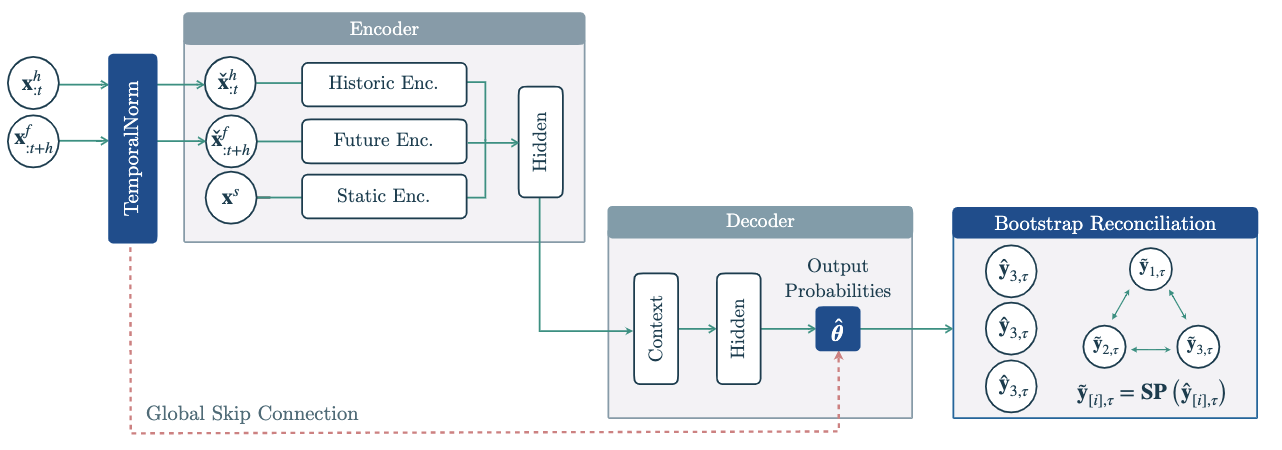 *Figure 1. Hierarchical Mixture Networks
(HINT).*
## 1. HINT
### `HINT`
```python theme={null}
HINT(h, S, model, reconciliation, alias=None)
```
HINT
The Hierarchical Mixture Networks (HINT) are a highly modular framework that
combines SoTA neural forecast architectures with a task-specialized mixture
probability and advanced hierarchical reconciliation strategies. This powerful
combination allows HINT to produce accurate and coherent probabilistic forecasts.
HINT's incorporates a `TemporalNorm` module into any neural forecast architecture,
the module normalizes inputs into the network's non-linearities operating range
and recomposes its output's scales through a global skip connection, improving
accuracy and training robustness. HINT ensures the forecast coherence via bootstrap
sample reconciliation that restores the aggregation constraints into its base samples.
*Figure 1. Hierarchical Mixture Networks
(HINT).*
## 1. HINT
### `HINT`
```python theme={null}
HINT(h, S, model, reconciliation, alias=None)
```
HINT
The Hierarchical Mixture Networks (HINT) are a highly modular framework that
combines SoTA neural forecast architectures with a task-specialized mixture
probability and advanced hierarchical reconciliation strategies. This powerful
combination allows HINT to produce accurate and coherent probabilistic forecasts.
HINT's incorporates a `TemporalNorm` module into any neural forecast architecture,
the module normalizes inputs into the network's non-linearities operating range
and recomposes its output's scales through a global skip connection, improving
accuracy and training robustness. HINT ensures the forecast coherence via bootstrap
sample reconciliation that restores the aggregation constraints into its base samples.
Available reconciliations
* BottomUp
* MinTraceOLS
* MinTraceWLS
* Identity
**Parameters:**
| Name | Type | Description | Default |
| ---------------- | -------------------------------------- | -------------------------------------------------------------------------------------------------------------------------------------- | ----------------- |
| `h` | [int](#int) | Forecast horizon. | *required* |
| `model` | NeuralForecast model | Instantiated model class from [architecture collection](./models.html). | *required* |
| `S` | [ndarray](#numpy.ndarray) | Dumming matrix of size (`base`, `bottom`) see HierarchicalForecast's [aggregate method](../hierarchicalforecast/utils.html#aggregate). | *required* |
| `reconciliation` | [str](#str) | HINT's reconciliation method from \['BottomUp', 'MinTraceOLS', 'MinTraceWLS']. | *required* |
| `alias` | [str](#str) | Custom name of the model. | None |
#### `HINT.fit`
```python theme={null}
fit(
dataset, val_size=0, test_size=0, random_seed=None, distributed_config=None
)
```
HINT.fit
HINT trains on the entire hierarchical dataset, by minimizing a composite log
likelihood objective. HINT framework integrates `TemporalNorm` into the neural
forecast architecture for a scale-decoupled optimization that robustifies
cross-learning the hierachy's series scales.
**Parameters:**
| Name | Type | Description | Default |
| ------------- | ---------------------------------------------------- | ------------------------------------------------------------------------- | ----------------- |
| `dataset` | [TimeSeriesDataset](#TimeSeriesDataset) | NeuralForecast's `TimeSeriesDataset` see details [here](./tsdataset.html) | *required* |
| `val_size` | [int](#int) | size of the validation set, (default 0). | 0 |
| `test_size` | [int](#int) | size of the test set, (default 0). | 0 |
| `random_seed` | [int](#int) | random seed for the prediction. | None |
**Returns:**
| Name | Type | Description |
| ------ | ---- | ------------------------------------- |
| `self` | | A fitted base `NeuralForecast` model. |
#### `HINT.predict`
```python theme={null}
predict(dataset, step_size=1, random_seed=None, **data_module_kwargs)
```
HINT.predict
After fitting a base model on the entire hierarchical dataset.
HINT restores the hierarchical aggregation constraints using
bootstrapped sample reconciliation.
**Parameters:**
| Name | Type | Description | Default |
| -------------- | ---------------------------------------------------- | ------------------------------------------------------------------------- | ----------------- |
| `dataset` | [TimeSeriesDataset](#TimeSeriesDataset) | NeuralForecast's `TimeSeriesDataset` see details [here](./tsdataset.html) | *required* |
| `step_size` | [int](#int) | steps between sequential predictions, (default 1). | 1 |
| `random_seed` | [int](#int) | random seed for the prediction. | None |
| `**data_kwarg` | | additional parameters for the dataset module. | *required* |
**Returns:**
| Name | Type | Description |
| ------- | ---- | ------------------------------------------------ |
| `y_hat` | | numpy predictions of the `NeuralForecast` model. |
### Usage Example
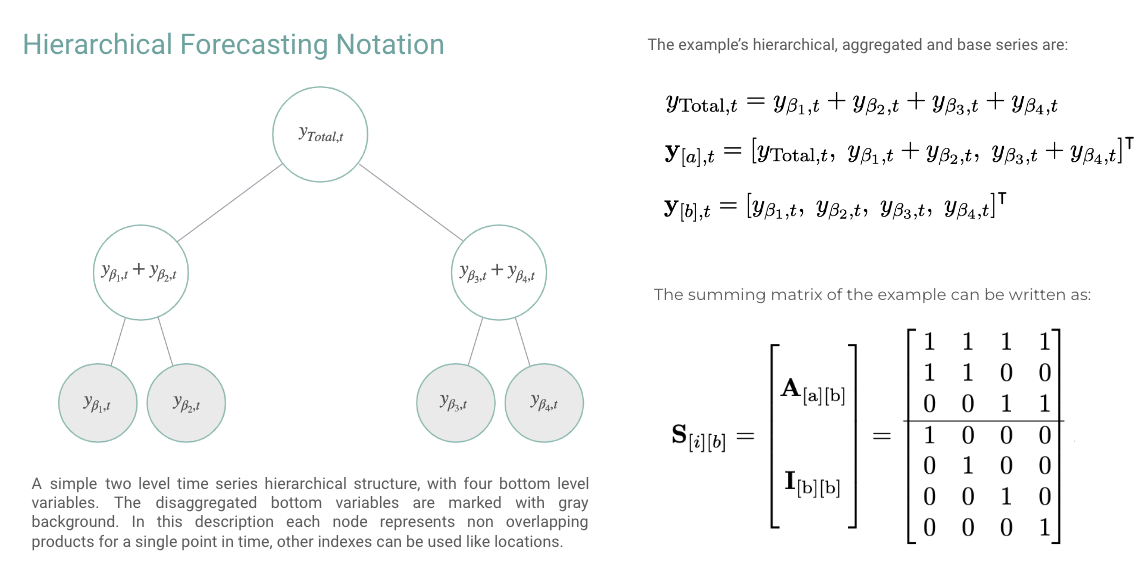
In this example we will use HINT for the hierarchical forecast task, a
multivariate regression problem with aggregation constraints. The
aggregation constraints can be compactcly represented by the summing
matrix $\mathbf{S}_{[i][b]}$, the Figure belows shows an example.
In this example we will make coherent predictions for the TourismL
dataset.
Outline:
1. Import packages
2. Load hierarchical dataset
3. Fit and Predict HINT
4. Forecast Plot
 ```python theme={null}
import matplotlib.pyplot as plt
from neuralforecast.losses.pytorch import GMM, sCRPS
from datasetsforecast.hierarchical import HierarchicalData
# Auxiliary sorting
def sort_df_hier(Y_df, S_df):
# NeuralForecast core, sorts unique_id lexicographically
# by default, this class matches S_df and Y_hat_df order.
Y_df.unique_id = Y_df.unique_id.astype('category')
Y_df.unique_id = Y_df.unique_id.cat.set_categories(S_df.index)
Y_df = Y_df.sort_values(by=['unique_id', 'ds'])
return Y_df
# Load TourismSmall dataset
horizon = 12
Y_df, S_df, tags = HierarchicalData.load('./data', 'TourismLarge')
Y_df['ds'] = pd.to_datetime(Y_df['ds'])
Y_df = sort_df_hier(Y_df, S_df)
level = [80,90]
# Instantiate HINT
# BaseNetwork + Distribution + Reconciliation
nhits = NHITS(h=horizon,
input_size=24,
loss=GMM(n_components=10, level=level),
max_steps=2000,
early_stop_patience_steps=10,
val_check_steps=50,
scaler_type='robust',
learning_rate=1e-3,
valid_loss=sCRPS(level=level))
model = HINT(h=horizon, S=S_df.values,
model=nhits, reconciliation='BottomUp')
# Fit and Predict
nf = NeuralForecast(models=[model], freq='MS')
Y_hat_df = nf.cross_validation(df=Y_df, val_size=12, n_windows=1)
Y_hat_df = Y_hat_df.reset_index()
```
```python theme={null}
# Plot coherent probabilistic forecast
unique_id = 'TotalAll'
Y_plot_df = Y_df[Y_df.unique_id==unique_id]
plot_df = Y_hat_df[Y_hat_df.unique_id==unique_id]
plot_df = Y_plot_df.merge(plot_df, on=['ds', 'unique_id'], how='left')
n_years = 5
plt.plot(plot_df['ds'][-12*n_years:], plot_df['y_x'][-12*n_years:], c='black', label='True')
plt.plot(plot_df['ds'][-12*n_years:], plot_df['HINT'][-12*n_years:], c='purple', label='mean')
plt.plot(plot_df['ds'][-12*n_years:], plot_df['HINT-median'][-12*n_years:], c='blue', label='median')
plt.fill_between(x=plot_df['ds'][-12*n_years:],
y1=plot_df['HINT-lo-90'][-12*n_years:].values,
y2=plot_df['HINT-hi-90'][-12*n_years:].values,
alpha=0.4, label='level 90')
plt.legend()
plt.grid()
plt.plot()
```
## 2. Reconciliation Methods
### `get_identity_P`
```python theme={null}
get_identity_P(S)
```
### `get_bottomup_P`
```python theme={null}
get_bottomup_P(S)
```
BottomUp Reconciliation Matrix.
Creates BottomUp hierarchical "projection" matrix is defined as:
```math theme={null}
\mathbf{P}_{\text{BU}} = [\mathbf{0}_{\mathrm{[b],[a]}}\;|\;\mathbf{I}_{\mathrm{[b][b]}}]
```
**Parameters:**
| Name | Type | Description | Default |
| ---- | -------------------------------------- | ------------------------------------------ | ---------- |
| `S` |
```python theme={null}
import matplotlib.pyplot as plt
from neuralforecast.losses.pytorch import GMM, sCRPS
from datasetsforecast.hierarchical import HierarchicalData
# Auxiliary sorting
def sort_df_hier(Y_df, S_df):
# NeuralForecast core, sorts unique_id lexicographically
# by default, this class matches S_df and Y_hat_df order.
Y_df.unique_id = Y_df.unique_id.astype('category')
Y_df.unique_id = Y_df.unique_id.cat.set_categories(S_df.index)
Y_df = Y_df.sort_values(by=['unique_id', 'ds'])
return Y_df
# Load TourismSmall dataset
horizon = 12
Y_df, S_df, tags = HierarchicalData.load('./data', 'TourismLarge')
Y_df['ds'] = pd.to_datetime(Y_df['ds'])
Y_df = sort_df_hier(Y_df, S_df)
level = [80,90]
# Instantiate HINT
# BaseNetwork + Distribution + Reconciliation
nhits = NHITS(h=horizon,
input_size=24,
loss=GMM(n_components=10, level=level),
max_steps=2000,
early_stop_patience_steps=10,
val_check_steps=50,
scaler_type='robust',
learning_rate=1e-3,
valid_loss=sCRPS(level=level))
model = HINT(h=horizon, S=S_df.values,
model=nhits, reconciliation='BottomUp')
# Fit and Predict
nf = NeuralForecast(models=[model], freq='MS')
Y_hat_df = nf.cross_validation(df=Y_df, val_size=12, n_windows=1)
Y_hat_df = Y_hat_df.reset_index()
```
```python theme={null}
# Plot coherent probabilistic forecast
unique_id = 'TotalAll'
Y_plot_df = Y_df[Y_df.unique_id==unique_id]
plot_df = Y_hat_df[Y_hat_df.unique_id==unique_id]
plot_df = Y_plot_df.merge(plot_df, on=['ds', 'unique_id'], how='left')
n_years = 5
plt.plot(plot_df['ds'][-12*n_years:], plot_df['y_x'][-12*n_years:], c='black', label='True')
plt.plot(plot_df['ds'][-12*n_years:], plot_df['HINT'][-12*n_years:], c='purple', label='mean')
plt.plot(plot_df['ds'][-12*n_years:], plot_df['HINT-median'][-12*n_years:], c='blue', label='median')
plt.fill_between(x=plot_df['ds'][-12*n_years:],
y1=plot_df['HINT-lo-90'][-12*n_years:].values,
y2=plot_df['HINT-hi-90'][-12*n_years:].values,
alpha=0.4, label='level 90')
plt.legend()
plt.grid()
plt.plot()
```
## 2. Reconciliation Methods
### `get_identity_P`
```python theme={null}
get_identity_P(S)
```
### `get_bottomup_P`
```python theme={null}
get_bottomup_P(S)
```
BottomUp Reconciliation Matrix.
Creates BottomUp hierarchical "projection" matrix is defined as:
```math theme={null}
\mathbf{P}_{\text{BU}} = [\mathbf{0}_{\mathrm{[b],[a]}}\;|\;\mathbf{I}_{\mathrm{[b][b]}}]
```
**Parameters:**
| Name | Type | Description | Default |
| ---- | -------------------------------------- | ------------------------------------------ | ---------- |
| `S` | [ndarray](#numpy.ndarray) | Summing matrix of size (`base`, `bottom`). | *required* |
**Returns:**
| Type | Description |
| ------------------------------------------------------------- | ----------- |
| np.ndarray: Reconciliation matrix of size (`bottom`, `base`). | |
References
* [Orcutt, G.H., Watts, H.W., & Edwards, J.B.(1968). "Data aggregation and information loss". The American Economic Review, 58 , 773(787)](http://www.jstor.org/stable/1815532).
### `get_mintrace_ols_P`
```python theme={null}
get_mintrace_ols_P(S)
```
MinTraceOLS Reconciliation Matrix.
Creates MinTraceOLS reconciliation matrix as proposed by Wickramasuriya et al.
```math theme={null}
\mathbf{P}_{\text{MinTraceOLS}}=\left(\mathbf{S}^{\intercal}\mathbf{S}\right)^{-1}\mathbf{S}^{\intercal}
```
**Parameters:**
| Name | Type | Description | Default |
| ---- | -------------------------------------- | ------------------------------------------ | ---------- |
| `S` | [ndarray](#numpy.ndarray) | Summing matrix of size (`base`, `bottom`). | *required* |
**Returns:**
| Type | Description |
| ------------------------------------------------------------- | ----------- |
| np.ndarray: Reconciliation matrix of size (`bottom`, `base`). | |
References
* [Wickramasuriya, S.L., Turlach, B.A. & Hyndman, R.J. (2020). "Optimal non-negative forecast reconciliation". Stat Comput 30, 1167-1182, https://doi.org/10.1007/s11222-020-09930-0](https://robjhyndman.com/publications/nnmint/).
### `get_mintrace_wls_P`
```python theme={null}
get_mintrace_wls_P(S)
```
MinTraceOLS Reconciliation Matrix.
Creates MinTraceOLS reconciliation matrix as proposed by Wickramasuriya et al.
Depending on a weighted GLS estimator and an estimator of the covariance matrix of the coherency errors $\\mathbf{W}\_{h}$.
```math theme={null}
\mathbf{W}_{h} = \mathrm{Diag}(\mathbf{S} \mathbb{1}_{[b]})
```
```math theme={null}
\mathbf{P}_{\text{MinTraceWLS}}=\left(\mathbf{S}^{\intercal}\mathbf{W}_{h}\mathbf{S}\right)^{-1}
\mathbf{S}^{\intercal}\mathbf{W}^{-1}_{h}
```
**Parameters:**
| Name | Type | Description | Default |
| ---- | -------------------------------------- | ------------------------------------------ | ---------- |
| `S` | [ndarray](#numpy.ndarray) | Summing matrix of size (`base`, `bottom`). | *required* |
**Returns:**
| Type | Description |
| ------------------------------------------------------------- | ----------- |
| np.ndarray: Reconciliation matrix of size (`bottom`, `base`). | |
References
* [Wickramasuriya, S.L., Turlach, B.A. & Hyndman, R.J. (2020). "Optimal non-negative forecast reconciliation". Stat Comput 30, 1167-1182, https://doi.org/10.1007/s11222-020-09930-0](https://robjhyndman.com/publications/nnmint/).