> ## Documentation Index
> Fetch the complete documentation index at: https://nixtlaverse.nixtla.io/llms.txt
> Use this file to discover all available pages before exploring further.
> BaseAuto class for hyperparameter optimization in NeuralForecast. Integrates Optuna, HyperOpt, Dragonfly through Ray for automated model tuning with cross-validation.
# Hyperparameter Optimization | NeuralForecast
Machine Learning forecasting methods are defined by many hyperparameters that
control their behavior, with effects ranging from their speed and memory
requirements to their predictive performance. For a long time, manual
hyperparameter tuning prevailed. This approach is time-consuming, **automated
hyperparameter optimization** methods have been introduced, proving more
efficient than manual tuning, grid search, and random search.
The
`BaseAuto` class offers shared API connections to hyperparameter optimization
algorithms like
[Optuna](https://docs.ray.io/en/latest/tune/examples/bayesopt_example.html),
[HyperOpt](https://docs.ray.io/en/latest/tune/examples/hyperopt_example.html),
[Dragonfly](https://docs.ray.io/en/releases-2.7.0/tune/examples/dragonfly_example.html)
among others through `ray`, which gives you access to grid search, bayesian
optimization and other state-of-the-art tools like
hyperband.
Comprehending the impacts of hyperparameters is still a
precious skill, as it can help guide the design of informed hyperparameter
spaces that are faster to explore automatically.
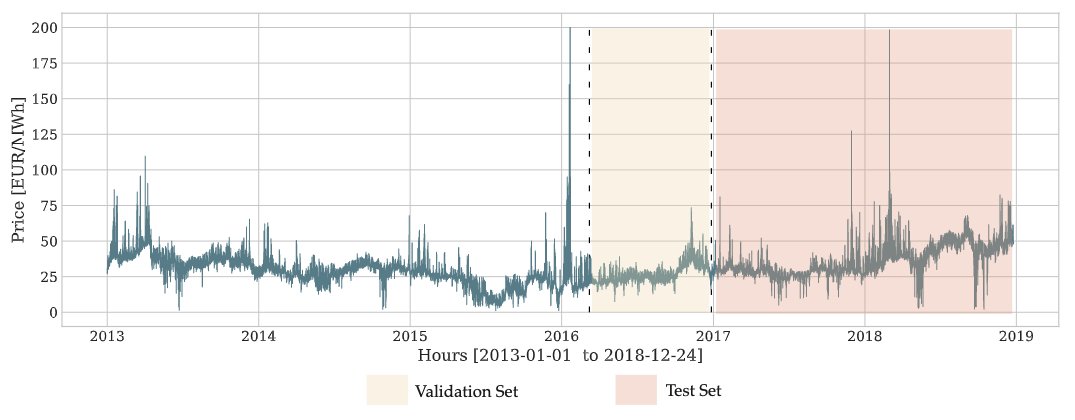 *Figure 1. Example of dataset split (left), validation (yellow) and test (orange). The hyperparameter optimization guiding signal is obtained from the validation set.*
##
### `BaseAuto`
```python theme={null}
BaseAuto(
cls_model,
h,
loss,
valid_loss,
config,
search_alg=BasicVariantGenerator(random_state=1),
num_samples=10,
time_budget=None,
refit_with_val=False,
verbose=False,
alias=None,
backend="ray",
callbacks=None,
ray_options=None,
optuna_options=None,
cpus=None,
gpus=None,
)
```
Bases:
*Figure 1. Example of dataset split (left), validation (yellow) and test (orange). The hyperparameter optimization guiding signal is obtained from the validation set.*
##
### `BaseAuto`
```python theme={null}
BaseAuto(
cls_model,
h,
loss,
valid_loss,
config,
search_alg=BasicVariantGenerator(random_state=1),
num_samples=10,
time_budget=None,
refit_with_val=False,
verbose=False,
alias=None,
backend="ray",
callbacks=None,
ray_options=None,
optuna_options=None,
cpus=None,
gpus=None,
)
```
Bases: [LightningModule](#pytorch_lightning.LightningModule)
Class for Automatic Hyperparameter Optimization, it builds on top of `ray` to
give access to a wide variety of hyperparameter optimization tools ranging
from classic grid search, to Bayesian optimization and HyperBand algorithm.
The validation loss to be optimized is defined by the `config['loss']` dictionary
value, the config also contains the rest of the hyperparameter search space.
It is important to note that the success of this hyperparameter optimization
heavily relies on a strong correlation between the validation and test periods.
**Parameters:**
| Name | Type | Description | Default |
| ---------------- | ----------------------------------------------------------------------------- | ------------------------------------------------------------------------------------------------------------------------------------------------------------------------------------------------------------------------------------------------------------------------------------------------------------------------------------------------------------------------------------------------------------------------ | ----------------------------------------------------------------------------------------------------------- |
| `cls_model` | PyTorch/PyTorchLightning model | See `neuralforecast.models` [collection here](./models.html). | *required* |
| `h` | [int](#int) | Forecast horizon | *required* |
| `loss` | PyTorch module | Instantiated train loss class from [losses collection](./losses.pytorch.html). | *required* |
| `valid_loss` | PyTorch module | Instantiated valid loss class from [losses collection](./losses.pytorch.html). | *required* |
| `config` | [dict](#dict) or [callable](#callable) | Dictionary with ray.tune defined search space or function that takes an optuna trial and returns a configuration dict. The config must include every parameter of the underlying model that has no default value (e.g. `input_size`, and `n_series` for multivariate models), either as a fixed value or as a search variable. `h`, `loss`, and `valid_loss` are injected automatically and must not be set in `config`. | *required* |
| `search_alg` | ray.tune.search variant or optuna.sampler | For ray see [https://docs.ray.io/en/latest/tune/api\_docs/suggestion.html](https://docs.ray.io/en/latest/tune/api_docs/suggestion.html) For optuna see [https://optuna.readthedocs.io/en/stable/reference/samplers/index.html](https://optuna.readthedocs.io/en/stable/reference/samplers/index.html). | [BasicVariantGenerator](#ray.tune.search.basic_variant.BasicVariantGenerator)(random\_state=1) |
| `num_samples` | [int](#int) | Number of hyperparameter optimization steps/samples. | 10 |
| `time_budget` | [int](#int) | Time budget in seconds for the hyperparameter search. | None |
| `refit_with_val` | [bool](#bool) | Refit of best model should preserve val\_size. | False |
| `verbose` | [bool](#bool) | Track progress. | False |
| `alias` | [str](#str) | Custom name of the model. | None |
| `backend` | [str](#str) | Backend to use for searching the hyperparameter space, can be either 'ray' or 'optuna'. | 'ray' |
| `callbacks` | list of callable | List of functions to call during the optimization process. ray reference: [https://docs.ray.io/en/latest/tune/tutorials/tune-metrics.html](https://docs.ray.io/en/latest/tune/tutorials/tune-metrics.html) optuna reference: [https://optuna.readthedocs.io/en/stable](https://optuna.readthedocs.io/en/stable) | None |
| `ray_options` | [RayOptions](#neuralforecast.common._base_auto.RayOptions) | Container for Ray-only options. See `RayOptions` for the supported fields (`run_config`, `scheduler`, `cpus`, `gpus`). Only used with `backend='ray'`. | None |
| `optuna_options` | [OptunaOptions](#neuralforecast.common._base_auto.OptunaOptions) | Container for Optuna-only options. See `OptunaOptions` for the supported fields (`study_kwargs`, `create_study_kwargs`). Only used with `backend='optuna'`. | None |
| `cpus` | | No longer supported as of v3.2.0. Pin neuralforecast to v3.1.9, or pass `ray_options=RayOptions(cpus=...)` instead. | None |
| `gpus` | | No longer supported as of v3.2.0. Pin neuralforecast to v3.1.9, or pass `ray_options=RayOptions(gpus=...)` instead. | None |
#### `BaseAuto.fit`
```python theme={null}
fit(
dataset, val_size=0, test_size=0, random_seed=None, distributed_config=None
)
```
BaseAuto.fit
Perform the hyperparameter optimization as specified by the BaseAuto configuration
dictionary `config`.
The optimization is performed on the `TimeSeriesDataset` using temporal cross validation with
the validation set that sequentially precedes the test set.
**Parameters:**
| Name | Type | Description | Default |
| ------------- | ------------------------------------------------- | --------------------------------------------------------------------------- | ----------------- |
| `dataset` | NeuralForecast's `TimeSeriesDataset` | NeuralForecast's `TimeSeriesDataset` see details [here](./tsdataset.html) | *required* |
| `val_size` | [int](#int) | Size of temporal validation set (needs to be bigger than 0). | 0 |
| `test_size` | [int](#int) | Size of temporal test set (default 0). | 0 |
| `random_seed` | [int](#int) | Random seed for hyperparameter exploration algorithms, not yet implemented. | None |
**Returns:**
| Name | Type | Description |
| ------ | ---- | -------------------------------------------------------------------- |
| `self` | | Fitted instance of `BaseAuto` with best hyperparameters and results. |
#### `BaseAuto.predict`
```python theme={null}
predict(dataset, step_size=1, h=None, **data_kwargs)
```
BaseAuto.predict
Predictions of the best performing model on validation.
**Parameters:**
| Name | Type | Description | Default |
| -------------- | ------------------------------------------------- | ------------------------------------------------------------------------------- | ----------------- |
| `dataset` | NeuralForecast's `TimeSeriesDataset` | NeuralForecast's `TimeSeriesDataset` see details [here](./tsdataset.html) | *required* |
| `step_size` | [int](#int) | Steps between sequential predictions, (default 1). | 1 |
| `h` | [int](#int) | Prediction horizon, if None, uses the model's fitted horizon. Defaults to None. | None |
| `**data_kwarg` | | Additional parameters for the dataset module. | *required* |
**Returns:**
| Name | Type | Description |
| ------- | ---- | ------------------------------------------------ |
| `y_hat` | | Numpy predictions of the `NeuralForecast` model. |
### Usage Example
```python theme={null}
class RayLogLossesCallback(tune.Callback):
def on_trial_complete(self, iteration, trials, trial, **info):
result = trial.last_result
print(40 * '-' + 'Trial finished' + 40 * '-')
print(f'Train loss: {result["train_loss"]:.2f}. Valid loss: {result["loss"]:.2f}')
print(80 * '-')
```
```python theme={null}
config = {
"hidden_size": tune.choice([512]),
"num_layers": tune.choice([3, 4]),
"input_size": 12,
"max_steps": 10,
"val_check_steps": 5
}
auto = BaseAuto(h=12, loss=MAE(), valid_loss=MSE(), cls_model=MLP, config=config, num_samples=2, cpus=1, gpus=0, callbacks=[RayLogLossesCallback()])
auto.fit(dataset=dataset)
y_hat = auto.predict(dataset=dataset)
assert mae(Y_test_df['y'].values, y_hat[:, 0]) < 200
```
```python theme={null}
def config_f(trial):
return {
"hidden_size": trial.suggest_categorical('hidden_size', [512]),
"num_layers": trial.suggest_categorical('num_layers', [3, 4]),
"input_size": 12,
"max_steps": 10,
"val_check_steps": 5
}
class OptunaLogLossesCallback:
def __call__(self, study, trial):
metrics = trial.user_attrs['METRICS']
print(40 * '-' + 'Trial finished' + 40 * '-')
print(f'Train loss: {metrics["train_loss"]:.2f}. Valid loss: {metrics["loss"]:.2f}')
print(80 * '-')
```
```python theme={null}
auto2 = BaseAuto(h=12, loss=MAE(), valid_loss=MSE(), cls_model=MLP, config=config_f, search_alg=optuna.samplers.RandomSampler(), num_samples=2, backend='optuna', callbacks=[OptunaLogLossesCallback()])
auto2.fit(dataset=dataset)
assert isinstance(auto2.results, optuna.Study)
y_hat2 = auto2.predict(dataset=dataset)
assert mae(Y_test_df['y'].values, y_hat2[:, 0]) < 200
```
### References
* [James Bergstra, Remi Bardenet, Yoshua Bengio, and Balazs Kegl
(2011). “Algorithms for Hyper-Parameter Optimization”. In: Advances
in Neural Information Processing Systems. url:
https://proceedings.neurips.cc/paper/2011/file/86e8f7ab32cfd12577bc2619bc635690-Paper.pdf](https://proceedings.neurips.cc/paper/2011/file/86e8f7ab32cfd12577bc2619bc635690-Paper.pdf)
* [Kirthevasan Kandasamy, Karun Raju Vysyaraju, Willie Neiswanger,
Biswajit Paria, Christopher R. Collins, Jeff Schneider, Barnabas
Poczos, Eric P. Xing (2019). “Tuning Hyperparameters without Grad
Students: Scalable and Robust Bayesian Optimisation with Dragonfly”.
Journal of Machine Learning Research. url:
https://arxiv.org/abs/1903.06694](https://arxiv.org/abs/1903.06694)
* [Lisha Li, Kevin Jamieson, Giulia DeSalvo, Afshin Rostamizadeh,
Ameet Talwalkar (2016). “Hyperband: A Novel Bandit-Based Approach to
Hyperparameter Optimization”. Journal of Machine Learning Research.
url:
https://arxiv.org/abs/1603.06560](https://arxiv.org/abs/1603.06560)